
“For many travelers, being thrust into an unfamiliar place returns them to a purer state of being.”
– Melissa Biggs Bradley, Founder and CEO of Indagare
By Realttorney®
Mendez is part of the third Growth Area, under the Cavite Provincial Development and Physical Framework Plan 2021 – 2030, known as Metro Tagaytay or the Tourism Haven and Food Basket of the Province. This third Growth Area is composed of Indang, Amadeo, Alfonso, Maragondon, three other municipalities, and one city, which will be featured in subsequent articles in the following weeks.
This is the fifth part of the series where we explore each LGU belonging to the Metro Tagaytay area. We share our experiences as we travel and visit the Metro Tagaytay area in the past to inform you of the interesting facts, business opportunities, and the state of the real estate in each LGU.
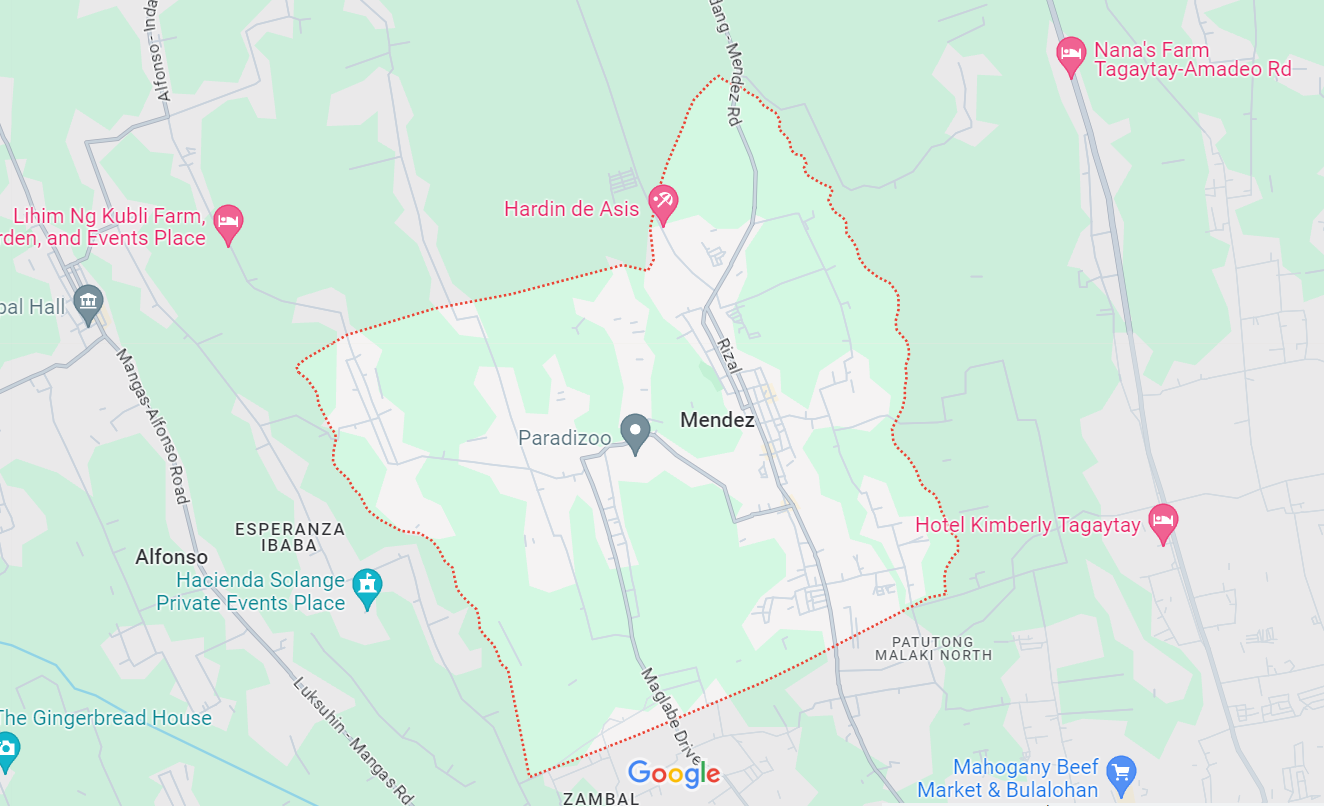
According to Wikipedia, Mendez is a 4th class municipality located in the southern part of the province of Cavite, Philippines. It is the smallest town in the Metro Tagaytay area in terms of land area – which is approximately 22 square kilometers. It is bounded to the north and east by Indang, to the South by Tagaytay City, and to the West by Alfonso.
While it may be the smallest town in upland Cavite, and less renowned as other tourist destinations like its neighbors to its South, Mendez has plenty to offer to its almost 35,000 residents and interested real estate investors seeking bargain deals. Here are some fascinating facts about Mendez, Cavite.
Official Name and History: Mendez is officially known as the Municipality of Mendez-Nuñez. It was originally known as “Gahitan“, one of the many barrios of Indang during the Spanish era. The name was derived from the word “gahit” meaning “to cut“, because the people then had to cut down tall and thick cogon grass that abounded in the place to clear areas for agricultural and residential purposes.
The history of Mendez, according to Wikipedia, says that when the houses in Gahitan increased in number the sitio graduated to become a barrio and finally a full-fledged town on 1 December 1875, thanks to Governor-General Jose Malcampo y Monje (1874-1877). Governor Malcampo incorporated the three barrios of Gahitan, Palocpoc, and Anuling into one independent municipality called Mendez-Nuñez, after a Spanish naval officer and close friend, Commodore Casto Mendez Nuñez.
Pedro Aure was the gobernadorcillo of Mendez during its first year as a municipality in 1876. Cayetano Aure, perhaps a relative of Pedro, was the first and only capitan municipal of Mendez during the First Philippine Republic (1899-1901).
Mendez continued to be a municipality from 1875 to October 15, 1903, when, under Act No. 947 of the Philippine Commission reduced the 23 municipalities of Cavite to eleven. Mendez and Bailen (now General Emilio Aguinaldo) were incorporated into the municipality of Alfonso.
But twelve (12) years later, on January 1, 1915, Mendez regained its independent status as a municipality of the Province of Cavite.
Geographic Appeal and Accessibility: Mendez is accessible via the Trece-Indang-Mendez-Tagaytay Road (actually a highway) if one is coming from the Capitol Compound in Trece Martires City. Another route is from the Aguinaldo Highway Exit of the Cavite-Laguna Expressway (CALAX) in Silang, one can use Aguinaldo Highway to Tagaytay City, and turn right at the Tagaytay-Alfonso Bypass Road.
When you reach the Indang-Mendez-Tagaytay Road intersection, turn right, and in less than 2 minutes you’ll be crossing the border of Mendez and Tagaytay City. When the bridge that connects Brgy. Patutong Malaki North and Brgy. Guinhawa North is fully constructed, one can use this to reach Brgys. Palocpoc, Anuling, and Panungyan via the Tagaytay-Alfonso Bypass Road, as well.
Several major road projects are planned by the Department of Public Works and Highways (DPWH) that will improve the mobility of residents and transients in the Metro Tagaytay area of Cavite. If all goes as planned, one of the interchanges of the Cavite-Tagaytay-Batangas Expressway (CTBEX) will be situated in the Municipality of Mendez-Nuñez, in between the interchanges in Amadeo, Cavite and Tagaytay City.
The increase in mobility and accessibility of real properties often brings an increase in the value of said real properties. So, expect a steady appreciation of land values in the entire Municipality of Mendez.
Meanwhile, the geographic location of Mendez is an advantage that it shares with the neighboring municipalities bounded by Tagaytay City. The cool climate of Mendez – described as tropical highland – is unmatched compared to other parts of Indang, Amadeo, and Silang with lower elevation. As such, events places, and resort-type developments have opened their doors to weary urban dwellers from the National Capital Region.
Economic Growth and Potential: Mendez is now home to the newly opened Mendez Specialist Medical Center along the Indang-Mendez-Tagaytay Road. Moreover, about 300 meters away from the hospital, a branch of McDonald’s opened its doors to hungry constituents of the Municipalities of Alfonso, Indang, and Mendez.
This shows the increased level of economic activity and great potential for growth by this 4th class Municipality. Imagine the types of business that will be established once the alignment of the Mendez Interchange of CTBEX has been confirmed. Commercial real estate ventures will increase. And, it may bring PEZA-registered ecozones near the exits of the interchange which can cater to the pool of qualified employees who are graduates of the Cavite State University Main Campus located in Indang, Cavite – less than 9 kilometers away from Mendez.
Potential as a High-Value Crops Center: Mendez was known for its agricultural products, particularly coffee, coconut, pineapple, and chayote. In the 1970s, the Municipalities of Amadeo, Indang, Mendez, and Alfonso had thousands of coffee trees that were harvested and brought a lot of wealth to its farmers. But those days have long been gone.
Still, the fertile soil and favorable climate make Mendez an ideal location for farming, which contributes to the local economy and provides employment opportunities for residents. The cool climate of Mendez is conducive to the planting and growing of strawberries and other highland vegetables or high-value commercial crops.
Under the provisions of the High-Value Crops Development Act of 1995 [Rep. Act No. 7900], “High-value crops (HVC)” are crops other than traditional crops which include, but are not limited to: coffee and cacao, fruit crops (citrus, cashew, guyabano, papaya, mango, pineapple, strawberry, jackfruit, rambutan, durian, mangosteen, guava, lanzones, and watermelon), root crops (potato and ubi), vegetable crops (asparagus, broccoli, cabbage, celery, carrots, cauliflower, radish, tomato, bell pepper, and patola), legumes, pole sitao (snap beans and garden pea), spices and condiments (black pepper, garlic, ginger, and onion), and cutflower and ornamental foliage plants (chrysanthemum, gladiolus, anthuriums, orchids, and statice).
There are numerous idle lands in the Municipality of Mendez, as well as nearby municipalities. When branded differently, this sleepy town can be a powerhouse High-Value Crops Center due to its favorable climate and abundance of water resources.
Despite the abundance of water, this important resource must be protected and conserved since the various waterways traversing the Municipality of Mendez-Nuñez are part of the Labac-Alemang River Watershed (LARW). It is important to know that watersheds are categorized under protected areas declared under the National Integrated Protected Areas System (NIPAS) Act of 1992 [Rep. Act No. 7586].
Healthy and protected watersheds provide critical services to humans, such as clean drinking water, productive fisheries, and outdoor recreation, that support local economies, and enhance the environment and the quality of life of the inhabitants. Hence, real estate investors must plan their investments in Mendez and most of the highlands of Cavite with this important concept or principle in mind.
Ideal Real Estate Projects and Investments in Mendez
Given its unique location and importance in protecting the Labac-Alemang River Watershed, Mendez should encourage these types of real estate development and investment:
Agricultural Estates: Despite its small land size, the Municipality of Mendez can establish model farms of high-value crops that can be replicated in the nearby towns of Indang and Amadeo. These farms can cross borders to achieve economies of scale in the production of the chosen HVCs.
However, an important feature of these estates should be the creation of numerous small water-impounding sites or areas to catch surface water during the rainy season and accumulate water that can possibly refill underground aquifers to strengthen the capacity of the watershed.
Finally, these estates must likewise implement processes that would prevent the contamination of the water resources by pesticides and other agricultural inputs. Or better yet, they should go organic if possible.
Farm Tourism Sites: With the benefits of the Farm Tourism Development Act of 2016 [Rep. Act No. 10816], investors can establish farm tourism camps in Mendez that allow visitors and tourists to visit, get involved in farm activities, and enjoy and learn rural lifestyle. This is in line with making Mendez the High-Value Crops Center of Metro Tagaytay, as well.
BPO Business Centers: With the opening of the Mendez Interchange of the CTBEX, the creation of the BPO-Technology Hub near the exits is an exciting opportunity. Why? Low cost of labor, low cost of living for the employees, and the dispersal of business and economic activity in the rural areas are positive factors for investors to consider.
Finally, PEZA-registered Agro-Industrial Zones can also be established near the Mendez Interchange. The small land area of Mendez will not hamper this since the lands in Indang can be utilized for expansion for such a venture since the latter is the Agro-Industrial Hub of the Metro Tagaytay Area.
In conclusion, Mendez-Nuñez, Cavite offers solid opportunities for real estate investments that will protect the environment and maintain the health of the watershed while at the same time introducing high-income industries that take advantage of the human resources of nearby municipalities. By leveraging these unique attributes, investors can establish business ventures that not only generate substantial returns but also contribute to the sustainable development and prosperity of this unfamiliar town in the Province of Cavite.
If this article resonates with you, let us start a conversation that may lead to providing employment opportunities to this part of the Metro Tagaytay area.
——-
Atty. Jojo is a real estate attorney, an estate planning attorney, a licensed real estate broker, and a PRC-accredited Lecturer/ Speaker for Training Programs in Real Estate. He is committed to helping new and veteran real estate service practitioners be well-informed of the latest laws, rules, regulations, and information relevant to the real estate service sector.
Discover more from Realttorney®
Subscribe to get the latest posts sent to your email.
 Realttorney®