Tag: inheritance

  • When a Co-Heir Refuses to Sign: What You Can Do

    When a Co-Heir Refuses to Sign: What You Can Do

    “No co-owner shall be obliged to remain in the co-ownership.”

    Civil Code, Art. 494
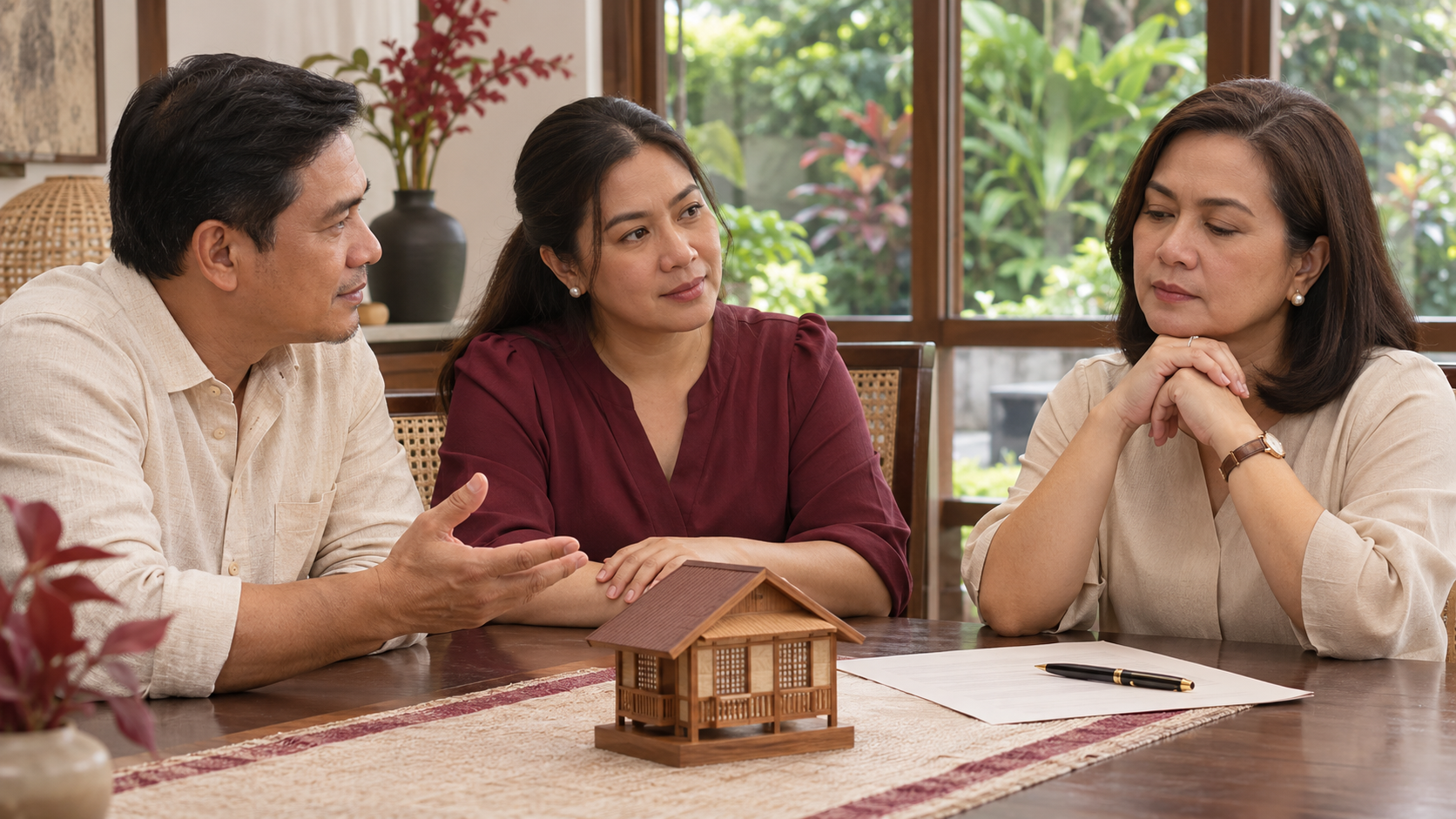
    Family members reviewing property documents at a table with one empty chair, illustrating a co-heir who refuses to sign.

    By Realttorney®

    This is the second article in our November series on estate settlement. Read the first: How to Sell the Property of a Dead Relative in the Philippines.

    When one heir refuses to sign, the other heirs cannot lawfully sell the whole property or sign for the holdout. They may sell only their own shares, or ask a court to partition the estate or, if the property cannot be divided, to order its sale. Bypassing the holdout puts the entire deal at risk.

    Why does one heir’s signature matter?

    Rights to a succession pass to the heirs from the moment of death (Civil Code, Art. 777). With two or more heirs, the estate is owned in common before partition, subject to the decedent’s debts (Art. 1078). Each heir owns an undivided share, not a particular corner of the lot.

    An extrajudicial settlement is the out-of-court way to divide an estate. Rule 74, Section 1 of the Rules of Court allows it only if the decedent left no will and no debts, and the heirs are all of age or the minors are duly represented. It is done by public instrument filed with the Registry of Deeds. The same section says no extrajudicial settlement binds anyone who did not participate in it or had no notice of it.

    Can the other heirs sell without the holdout?

    Only their own shares. A co-owner may sell her part, but the sale affects only the portion allotted to her when the co-ownership ends (Art. 493). In Neri v. Heirs of Uy (G.R. No. 194366, October 10, 2012), the Supreme Court held that the signing heirs could sell only their proportionate shares, and the buyers became co-owners with the heirs who were left out.

    In our practice as licensed real estate brokers or accredited real estate salespersons, a share-only purchase is a hard market for buyers and lenders who want the entirety of the lot with a clean title.

    If an heir sells his hereditary rights to a stranger before partition, the co-heirs, including the holdout, may take the buyer’s place by reimbursing the price within one month from written notice of the sale (Art. 1088).

    What if the others sign anyway and leave the holdout out?

    The extrajudicial settlement is void as to the preterited heir. Neri case, quoting Segura v. Segura (G.R. No. L-29320, September 19, 1988), calls an extrajudicial settlement that omits an heir a total nullity as to that preterited heir. The Court also held that the two-year period did not apply to heirs deprived of their lawful share. Remember, the general rule is that no one can give what he does not have.

    Hence, even if the buyer purchased the entire lot by virtue of the extrajudicial settlement of estate signed by the heirs in agreement (less the excluded heir), the former became the owner of the portion that was validly sold to him. The rest of the property is still owned by the preterited heir.

    In effect, the buyer became a pro indiviso co-owner with the excluded heirs, and holds the share of the excluded heir under an implied trust. Hence, an action for reconveyance of property held in implied trust does not prescribe.

    However, this is true only as long as the trustee continues to acknowledge the title of the cestui que trust, or stated otherwise, provided she does not repudiate such title.

    The moment she does so, the prescriptive period will begin to run and may eventually operate to divest the real owners of their right to the property after the lapse of the applicable statutory period. Hence, an action to recover the property held in trust (an obligation created by law) prescribes in ten years, counted from the actual date of repudiation (the registration of a new Torrens title under a new owner).

    In plain terms: the excluded heir has the right to claim her share, provided she acts swiftly to force the seller to return the price for that share or portion of the property. But, in the hands of a buyer in good faith and for value, the excluded heir may not unravel the deal years later, if she slept on her rights.

    What is the two-year period in Section 4, Rule 74?

    If, within two years after settlement and distribution, an heir or other person appears to have been unduly deprived of her lawful share, she may compel the settlement of the estate in court. The heir’s bond and the real estate stay charged with liability for those two years, even after transfers. Section 5 gives a minor, an incapacitated person, or one in prison or outside the Philippines one more year after the disability ends.

    What can the other heirs lawfully do?

    • Negotiate. Learn why the heir refuses: price, mistrust, or unpaid debts. A buy-out of her share can end many standoffs. This is opinion, not law.
    • File an ordinary action for partition. Rule 74, Section 1 provides that heirs who disagree may proceed this way, and Art. 494 lets any co-owner demand partition at any time as to his share. Partition is by agreement or by judicial proceedings (Art. 496).
    • Ask for a sale if the property cannot be divided. When it is essentially indivisible, and the co-owners cannot agree on who takes it and pays the others, it is sold and the proceeds distributed (Art. 498). Reyes v. Concepcion (G.R. No. 56550, October 1, 1990) upheld a public sale, and Aguilar v. Court of Appeals (G.R. No. 76351, October 29, 1993) held that either co-owner may demand a sale and the other cannot object. Both cases involved ordinary co-owners, not an estate. Hence, applying them to heirs, who are co-owners before partition under Art. 1078, is our interpretation.
    • Go to court if there is a will or a debt. Rule 74, Section 1 then does not apply, and an administrator may sell estate real property only with court authority (Rule 89).

    A hypothetical case

    Ana, Ben, and Carla inherited a titled parcel of land with no will and no debts. Ana and Ben have a buyer. Carla, who lives abroad, thinks the price is too low. If Ana and Ben sell without her, the settlement is void as to Carla. The legal and safer paths are: (1) to engage a licensed real estate appraiser to get the latest market value; (2) propose a buy-out of her share based on the appraised value; or (3) if this fails, file a court action for partition or sale.

    For brokers and salespersons

    Practice tip: Do not market or advertise the whole property nor collect earnest money for a co-owned property until every heir has signed or a court has ruled on the sale. Always secure the full and complete list of heirs, and refer the family to an attorney before lining up a buyer.

    Frequently asked questions

    Can the other heirs sign for the holdout? Not without his authority. A contract in another’s name without authority is unenforceable unless ratified (Arts. 1317 and 1403, as quoted in Neri).

    Can one heir sell his share alone? Yes, but only his share (Art. 493), and the co-heirs may redeem within one month from written notice (Art. 1088).

    Does the two-year period protect a buyer? Not against an excluded heir (Neri case).

    Can a court force the holdout to sell? A court can order partition and, if the property cannot be divided and the heirs cannot agree, a sale with the proceeds distributed (Art. 498). The remedy is a judgment, not his signature.

    Facing a holdout heir? Book a consultation with Realttorney at realttorney.com.


    This article is for general information only and is not legal advice. Consult a lawyer about your specific situation.

    About the Author

    Atty. Jojo Perez is a real estate and estate planning attorney, a licensed real estate broker, and a PRC‑accredited lecturer and speaker on real estate topics. Through Realttorney®, he helps property owners, investors, and real estate professionals understand the legal principles and practical considerations involved in property ownership, foreclosure, and real estate transactions in the Philippines.

  • Inheritance Wars: Understanding the Intricacies of Family Disputes in Estate Matters

    “The best inheritance a parent can give to his children is a few minutes of their time each day.”

    – M. Grundler, Author

    By Realttorney®

    Inheritance is often viewed as a means of passing on wealth and assets to the next generation, providing financial security and stability for future generations. However, what should be a straightforward process can sometimes turn into a contentious and emotionally charged situation, with families engaging in bitter disputes over inheritance.

    Inheritance disputes can arise for various reasons, and they can have a profound impact on family relationships and financial well-being. In this article, we will explore the complexities of why families fight over inheritance and provide insights into how such disputes can be prevented or resolved.

    The Emotional Dynamics of Inheritance

    Inheritance disputes are not just about money and assets. They often involve complex and deep-seated emotional dynamics that can intensify conflicts among family members. When a loved one passes away, the grieving process can be overwhelming, and emotions can run high, which stresses the relationship and cause a rift.

    The distribution of inheritance can bring up deep-seated emotions, such as feelings of entitlement, jealousy, resentment, and betrayal, which can ignite conflicts among family members. Additionally, unresolved family issues, past grievances, and long-standing sibling rivalries can resurface during the estate settlement process, further exacerbating tensions.

    Family members may also have different perceptions of what is fair and equitable when it comes to inheritance. Some may feel entitled to a larger share of the estate based on their contributions or sacrifices, while others may believe that the estate should be divided equally among all heirs. These differing views can lead to disagreements and disputes, as each family member may have their own perspective on what is fair and just. A case in point here is the settlement of the estate of the late Ricardo Yanson, Sr., former head of the biggest transportation company in the Philippines.

    Inheritance can also be tied to family dynamics and expectations. For example, if a parent promised a certain heirloom or piece of property to one family member but did not explicitly include it in the estate plan, it can lead to disputes and disagreements among heirs. Unmet expectations and unfulfilled promises can create disappointment, frustration, and tension within the family, and may ultimately result in legal battles over the inheritance.

    Financial Considerations and Unequal Distribution

    Another common reason for inheritance disputes is financial considerations and the unequal distribution of assets. In some cases, a family member may be designated as the executor or trustee of the estate, responsible for distributing the assets according to the terms of the estate plan. However, conflicts can arise if there are discrepancies in the distribution or if the executor or trustee is perceived to be favoring one beneficiary over others.

    Unequal distribution of assets can also occur when there are blended families, with stepchildren or step-siblings involved. In such cases, disputes may arise over how assets are divided among biological children and stepchildren, especially if there are different levels of closeness or relationship dynamics among the siblings. If one is part of a blended family then it is a must that he or she create an estate plan that will ensure family unity after the decedent passes away.

    Complex family structures, such as second marriages, or families with children from different relationships, can further complicate the distribution of assets and increase the likelihood of inheritance disputes. Moreover, different interpretations of the decedent’s wishes, unclear or ambiguous estate planning documents, or inadequate communication about the estate plan can all contribute to conflicts among family members.

    Lack of Estate Planning or Inadequate Estate Plan

    Another common factor that can lead to inheritance disputes is the absence of estate planning or an inadequate estate plan. In some cases, individuals may pass away intestate (or without a will) or other estate planning documents, leaving their assets to be distributed according to the Law on Intestate Succession under the New Civil Code of the Philippines. Most of the time, the provisions of the Civil Code may not align with the deceased’s wishes or the expectations of the heirs, leading to disputes over asset distribution.

    In addition, even when an estate plan is in place, it may not be comprehensive or up to date, leading to potential ambiguities or omissions that can trigger conflicts among family members. For example, outdated beneficiary designations, lack of clarity in the distribution of specific assets, or failure to consider all potential scenarios can all contribute to disputes over inheritance. Take note, inadequate estate planning can leave room for interpretation and misunderstanding, leading to conflicts among family members who may have different interpretations of the deceased’s wishes or intentions.

    Legal and Financial Complexities

    Inheritance disputes can also arise due to legal and financial complexities. Probate is a court process that involves the validation and administration of a testator’s will. Meanwhile, judicial settlement of estate happens when a person dies intestate or without executing a will. Both can be complex and time-consuming especially when numerous legal heirs of the estate are not in agreement as to the distribution of the remaining assets after payment of all debts and liabilities.

    These court proceedings involve various legal requirements, such as filing documents with the court, paying off debts and taxes, and distributing assets according to the will or the law on intestacy. Disputes can, and almost always, arise during this process, such as challenges to the validity of the will, allegations of undue influence or fraud, or disputes over the provisions of the will and the clear intentions of the testator.

    Moreover, high-value assets, such as real estate, investments, or business interests, can add further complexity to the estate settlement process. Valuation of such assets may be subjective and can be a source of disagreement among family members. In addition, disputes may arise over how these assets are to be managed or distributed, particularly if there are disagreements on their worth or the terms of their transfer.

    In some cases, family members may also have different financial needs or expectations from the inheritance. For example, some heirs may be in need of immediate cash for financial obligations, while others may prefer to keep the assets for the long term. These differing financial interests and priorities can create conflicts among family members and contribute to inheritance disputes, as it often does.

    Breakdown of Communication and Trust

    The breakdown of communication and trust can be another significant factor that leads to inheritance disputes. Communication is crucial in estate planning to ensure that family members have a clear understanding of the deceased’s wishes and intentions.

    However, if communication is lacking or inadequate, misunderstandings can and will arise, and family members may feel left out or excluded from the decision-making process. This can create a sense of mistrust and resentment, leading to disputes over inheritance.

    In some cases, communication breakdown may also be due to family dynamics, such as strained relationships, lack of open communication, or unresolved conflicts from the past. These underlying issues can resurface during the estate settlement process and may impact the ability of family members to communicate effectively and resolve disputes amicably.

    Legal battles and disputes over inheritance can further strain family relationships and erode trust among family members. The emotional toll of litigation, the cost of legal fees, and the public nature of court proceedings can create lasting rifts within the family and may result in severed relationships that are difficult to repair.

    Again, the case of the estate of the late Ricardo Yanson, Sr. is a great and shining example of how a poorly planned or lack of a comprehensive estate plan can lead to strained family relationships and deep resentment between siblings and the surviving parent. Harsh words have been exchanged publicly and smear campaigns on both sides went on for months on end.

    How to Prevent or Resolve Inheritance Disputes

    While inheritance disputes can be complex and challenging, there are steps that families can take to prevent or resolve them.

    Comprehensive Estate Planning: Having a comprehensive estate plan in place can minimize the likelihood of disputes over inheritance. This includes having a valid and up-to-date pour-over will, an irrevocable living trust, and other estate planning documents that clearly outline the deceased’s wishes and intentions. It is crucial to work with an experienced estate planning attorney to ensure that the estate plan is legally sound and addresses all relevant aspects, including asset distribution, the appointment of executors or trustees, and contingency plans for different scenarios.

    Clear Communication: Open and transparent communication among family members is key to preventing misunderstandings and disputes over inheritance. The estate planner must be open to this idea of talking about his or her mortality. It is important to have open conversations about estate planning, clarify the deceased’s intentions, and address any concerns or expectations that family members may have. This can help to build trust, minimize misinterpretations, and ensure that everyone is on the same page.

    Fair Distribution: Fair and equitable distribution of assets can also help to prevent disputes over inheritance. But, remember, fair does not mean equal. It is important to consider the needs and expectations of all heirs and strive for an equitable distribution that takes into account the contributions, sacrifices, and circumstances of each family member.

    This may involve seeking professional advice on asset valuation, setting up an irrevocable trust, and securing life insurance policies for other heirs in order to somehow “equalize” the distribution of the estate to the heirs.

    If you want to learn more about how life insurance serves as an estate planning tool, you can click on this link to read the article — Securing Your Legacy.

    Image source: https://washingtonpost.com

    ——-

    Atty. Jojo is a real estate attorney, an estate planning attorney, a licensed real estate broker, and a PRC-accredited Lecturer/ Speaker for Training Programs in Real Estate. He is a Chartered Trust and Estate Planning (CTEP®) professional who is committed to educating Filipinos about the value and importance of having an estate plan in their lives.

  • Is Estate Planning for Rich People Only?

    “Sometimes the poorest man leaves his children the richest inheritance.”

    – Ruth E. Renkel, Author

    By Realttorney®

    Estate planning is often seen as a practice reserved for the wealthy, conjuring images of mansions, yachts, and enormous amounts of money. Many people assume that only the rich need to worry about estate planning, while others may feel that estate planning is a complex and unnecessary task that only applies to those with a large asset base.

    However, this common misconception could not be further from the truth. Estate planning is not just for the rich or “high-net-worth individuals”. Estate planning is a crucial process that everyone, regardless of wealth status, should consider to protect their assets, their loved ones, and their legacy.

    As a side note, a “high-net-worth individual” is someone whose net estate (where all assets such as real property/ies, businesses, investments, and cash, minus any liabilities) is estimated to be at least P100,000,000 or more. Now, this amount is a random number. It may go down as low as P50,000,000 or north of P150,000,000. But, the key here is liquidity.

    Estate planning offers many benefits, such as asset protection, planning for major life events, tax savings, and transferring of wealth. Through estate planning, individuals can ensure that their assets and wealth are distributed according to their wishes. It also helps them to prepare for potential life changes, such as retirement, incapacity or death. Additionally, estate planning can help to minimize taxes, making the most of the individual’s wealth.

    Contrary to popular belief, estate planning is not solely about money or the size of one’s estate. While wealthy individuals may have more complex estates with a higher value of assets to manage, estate planning is relevant for individuals of all income levels. Here are several key reasons why estate planning is not just for the wealthy:

    Protecting Minor Children: Estate planning allows parents to designate guardians for their minor children in the event of their death or incapacitation. This is a critical aspect of estate planning that applies to all parents, regardless of their financial status.

    Without proper estate planning, a court may appoint a guardian for the children, and it may not align with the parent’s wishes. Estate planning provides an opportunity for parents to name a guardian who will raise and care for their children according to their values and beliefs, in the event that both parents pass suddenly.

    Managing Healthcare Decisions: Estate planning also involves creating documents such as a health care directive or a living will that specifies an individual’s wishes for medical treatment and end-of-life care. This is not limited to the wealthy; it applies to everyone.

    Estate planning allows individuals to appoint someone to make healthcare decisions on their behalf if they are unable to do so. This can provide peace of mind and ensures that an individual’s medical treatment aligns with their values and preferences, regardless of their financial status.

    Avoiding Probate: Probate is a special proceeding mandatorily required for the purpose of establishing the validity of a will. It can be time-consuming, costly, and public. Estate planning can help individuals avoid probate or minimize its impact.

    This is relevant for individuals of all income levels, as probate proceedings are costly, and the complexity of probate depends on the size of the estate. If you have meager resources then the more it is important for you to consider estate planning to save on court costs, lawyer’s fees, and other expenses.

    By creating a trust or implementing other estate planning strategies, individuals can ensure that their assets pass directly to their heirs outside of probate, allowing for a smoother and more private distribution of their estate.

    Preserving Family Harmony: Estate planning can help avoid conflicts among family members that may arise after an individual’s death. Disputes over assets, inheritance, and distribution can often strain family relationships and cause irreparable damage.

    Estate planning provides an opportunity for individuals to clearly outline their wishes and intentions, minimizing the potential for conflicts among family members. This is important for all families, regardless of their wealth or financial status, as family disputes can occur at any level of income.

    Protecting Assets from Creditors or Lawsuits: Estate planning can also help protect an individual’s assets from creditors or lawsuits. This is not limited to the wealthy, as anyone can face potential liabilities or legal claims. Through estate planning techniques such as irrevocable trusts, individuals can safeguard their assets from potential creditors or legal actions. This can be particularly important for individuals who have valuable assets such as a home, investments, or a business, regardless of their level of wealth.

    Charitable Giving: Estate planning provides an opportunity for individuals to leave a legacy by supporting charitable causes that are important to them. Charitable giving is not limited to the wealthy; individuals of all income levels can incorporate philanthropy into their estate planning.

    Through various estate planning tools such as charitable trusts or bequests in a will, individuals can make a meaningful impact and leave a lasting legacy by supporting charitable organizations and causes that align with their values and beliefs.

    Business Succession Planning: If an individual owns a business, estate planning can be crucial for ensuring its smooth transition to the next generation or a designated successor. This applies to small business owners and entrepreneurs, not just large corporations.

    Business succession planning can help preserve the continuity and success of a business, protect the interests of other shareholders or partners, and ensure that the business continues to operate according to the owner’s vision and wishes after he/she passes away.

    Tax Planning: While tax planning may seem like a concern only for the wealthy, it is an essential aspect of estate planning that applies to individuals at all income levels. Proper estate planning can help minimize the tax implications of transferring assets to heirs or beneficiaries, regardless of the size of the estate.

    Strategies such as gifting, setting up trusts, or creating a charitable remainder trust can help individuals reduce their estate tax liabilities and maximize the number of assets that pass on to their loved ones.

    Planning for Incapacity: Estate planning also involves planning for incapacity, which can happen to anyone regardless of their financial status. In the event that an individual becomes mentally or physically incapacitated and is unable to make decisions for themselves, estate planning documents such as powers of attorney and living trusts can ensure that their financial and healthcare decisions are managed according to their wishes.

    Planning for incapacity is important for all individuals to ensure that their interests are protected and their healthcare and financial affairs are managed in their best interests. A case in point is the situation of Avelino “Samboy” Lim.

    The Skywalker collapsed on the bench during an exhibition game in November 2014. He fell into a coma for five weeks due to cardiac arrest. He is currently wheelchair-bound and unable to speak and see. Of course, this incapacity was unplanned and sudden.

    Peace of Mind: Lastly, estate planning provides peace of mind, knowing that one’s assets, loved ones, and wishes are protected and accounted for. It can be a source of comfort for individuals at all income levels to know that their affairs are in order, and their loved ones are taken care of according to their wishes.

    Estate planning allows individuals to have control over their legacy and provides them with the assurance that their assets and wishes will be managed according to their intentions, regardless of their level of wealth.

    In conclusion, we reiterate that estate planning is not just for the wealthy. It is a critical process that applies to individuals of all income levels. Remember, estate planning is not solely about money or the size of one’s estate.

    Estate planning allows individuals to have control over their assets, legacy, and wishes and ensures that their loved ones are taken care of according to their intentions. It encompasses various aspects such as protecting minor children, managing healthcare decisions, avoiding probate, preserving family harmony, protecting assets, charitable giving, business succession planning, tax planning, planning for incapacity, and providing peace of mind.

    By taking the time to plan, individuals can rest assured that their estate is in order when the inevitable happens. Therefore, it is never too early to start estate planning, regardless of one’s level of wealth. In fact, the earlier one starts, the more time they have to develop a comprehensive plan that aligns with their changing circumstances and goals.

    Finally, it is important to consult with a qualified and experienced estate planning attorney or financial professional to help navigate the complexities of estate planning and create a customized plan that meets one’s specific needs and objectives.

    ——-

    Atty. Jojo is a real estate attorney, an estate planning attorney, a licensed real estate broker, and a PRC-accredited Lecturer/ Speaker for Training Programs in Real Estate. He is a Chartered Trust and Estate Planning (CTEP®) professional who is committed to educating Filipinos about the value and importance of having an estate plan in their lives.

  • Can Aliens Inherit Land in the Philippines?

    Under the Constitution aliens may not acquire private or public agricultural lands, including residential lands…

    – Mr. Chief Justice Manuel V. Moran, Krivenko vs. Register of Deeds

    By Realttorney®

    No, we will not be discussing those non-earth beings. We are going to talk about aliens who are earthly beings belonging to a foreign country or nation. Plainly speaking, non-Filipino citizens.

    A colleague of mine sent an email requesting advice regarding her client. The part of the email is quoted as follows:

    “I would want to consult with you regarding the concern of my client. The husband is a foreigner and the wife is a Filipina. The husband’s concern is that: in case his wife passes away ahead of him, what will happen to the property (house and lot in Las Piñas City) they are buying. What is the remedy that the family of his wife will not demand right to the property leaving him helpless, they don’t have any kid.”

    I first lectured on the topic “Foreign Ownership of Land and Real Estate” in February 2011. Since more than a decade has passed, let us revisit the topic of foreign ownership of land in the Philippines and one of its exceptions.

    We’ll also revisit a 40-year-old jurisprudence promulgated by the Supreme Court and shed a new interpretation that is not commonly discussed in various online articles posted on various websites. Of course, an in-depth discussion on the Law on Succession under the Civil Code of the Philippines and how it affects the transfer of real property to foreigners who are legally married to Filipino spouses via last will and testament.

    It is a common occurrence that when an alien spouse marries a Filipino citizen, the former is the main source of funds for the purchase of a house and lot in the Philippines. Thereafter, the real property will be registered in the name of the Filipino spouse.

    As real estate brokers, we know the answer to the question: Can aliens buy land in the Philippines? As a general rule, only Filipino citizens (natural or juridical) can own land in this country. Accordingly, foreigners are not allowed to own land in the Philippines. This is a constitutional prohibition that will not be changed anytime soon.

    But every general rule has exceptions. One particular exception to the general rule written above is Section 7, Article XII of the 1987 Philippine Constitution, which is quoted hereunder:

    “Section 7. Save in cases of hereditary succession, no private lands shall be transferred or conveyed except to individuals, corporations, or associations qualified to acquire or hold lands of the public domain.”

    The case of Krivenko vs. Register of Deeds (G.R. No. L-630, November 15, 1947) eloquently discussed the purpose for the same provision in the 1935 Philippine Constitution – then Section 5, Article XIII, to wit:

    “…section 5 is intended to insure (sic) the policy of nationalization contained in section 1 [Article XIII of the 1935 Constitution]. Both sections must, therefore, be read together for they have the same purpose and the same subject matter. It must be noticed that the persons against whom the prohibition is directed in section 5 are the very same persons who under section 1 are disqualified ‘to acquire or hold lands of the public domain in the Philippines.’ And the subject matter of both sections is the same, namely, the non-transferability of ‘agricultural land’ to aliens.” (boldfacing ours, for emphasis)

    In the end, the Krivenko doctrine clearly held that “under the Constitution, aliens may not acquire private or public agricultural lands, including residential lands.” However, because of Section 7 [then Section 5, Article XIII of the 1935 Constitution] aliens are given a chance to own real estate in the Philippines. It is clear that aliens can own real estate in the Philippines through hereditary succession.

    To answer the question stated above, if the Filipina passes away before the alien spouse then the latter will be able to own a part of the real estate registered in the name of the Filipina wife through hereditary succession. Of course, this is under the assumption that the marriage between the Filipina and the alien spouse is considered legal under Philippine laws.

    But, what does “hereditary succession” actually mean? Can the foreigner own the land if it was bequeathed to him/her by the Filipino spouse through a last will and testament? And, what part of the property will the alien spouse own in the end, after the estate of the Filipino spouse has been settled?

    In layman’s terms, hereditary succession is the passing or division of an estate when a person dies without a will. It is also known as intestate succession. Therefore, the 1987 Constitution is clear that the only way an alien spouse can own real estate in the Philippines is through intestate succession. Hence, the Filipina spouse must not execute any will (notarial or holographic) during her lifetime bequeathing her real property to her alien spouse. She must die intestate. That is the constitutional edict.

    And according to various lawyer-authors, bequeathing the real property to alien spouses through a will shall be contrary to the dictates of the Supreme Court of the Philippines in the case of The Testate Estate of Jose Eugenio Ramirez vs. Marcelle Vda. De Ramirez, et al. (G.R. No. L-27952, February 15, 1982).

    However, as an estate planning attorney, I would never recommend that a Filipino pass away intestate. The default estate plan of the State is contained in the provisions of the Law of Intestate Succession – Articles 960 to 1014, and numerous provisions in Chapter 4 [Provisions Common to Testate and Intestate Successions], Title IV of Book III of the Civil Code of the Philippines. Following the estate plan of the State is not the best way to dispose of one’s properties after passing away.

    Hence, if a Filipino spouse passes away intestate and there are no other legitimate descendant, ascendant, or sibling who survives with the alien spouse, the latter will inherit the entire estate of the former. Article 995 of the Civil Code mandates this.

    According to Article 997 “When the widow or widower survives with legitimate parents or ascendants, the surviving spouse shall be entitled to one-half of the estate, and the legitimate parents or ascendants to the other half.”

    However, “should brothers and sisters or their children survive with the widow or widower, the latter shall be entitled to one-half of the inheritance and the brothers and sisters or their children to the other half.” This is provided by Article 1001 of the Civil Code.

    So, let us revisit Ramirez vs. Vda. De Ramirez to get a fresh perspective as to what other successional rights an alien spouse has based on his valid marriage to a Filipino spouse. Keep in mind that Jose Eugenio Ramirez is a Filipino, while Marcelle Vda. De Ramirez is the widow who is a French citizen. And, they had no children between them.

    The part of the decision that has been quoted numerous times by lawyer-authors in the case of Ramirez vs. Vda. De Ramirez is this:

    “We are of the opinion that the Constitutional provision which enables aliens to acquire private lands does not extend to testamentary succession for otherwise the prohibition will be for naught and meaningless. Any alien would be able to circumvent the prohibition by paying money to a Philippine landowner in exchange for a devise of a piece of land.”

    When read plainly, it seems that the Supreme Court prohibits the acquisition of land by an alien through testamentary succession for the simple reason that if allowed “the prohibition will be for naught and meaningless.” However, this is a mere obiter dictum of our Supreme Court.

    For the laymen, an obiter dictum is an opinion “uttered by the way, not upon the point or question pending, as if turning aside from the main topic of the case to collateral subjects,” or the opinion of the court upon any point or principle which it is not required to decide, or an opinion of the court which does not embody its determination and is made without argument or full consideration of the point and is not professed deliberate determinations of the judge himself. (People of the Philippines vs. Hon. Higinio Macadaeg, et al., G.R. No. L-4316, May 28, 1952)

    Why do I say that this pronouncement of the Court is a mere obiter dictum? The pronouncement was made while the Court was discussing the “appellants claim that the usufruct over real properties of the estate in favor of Wanda [the companion of Jose Eugenio Ramirez, who is an Austrian] is void because it violates the constitutional prohibition against the acquisition of lands by aliens.”

    The next paragraph in the decision is very telling, and I quote:

    “This opinion notwithstanding, We uphold the usufruct in favor of Wanda because a usufruct, albeit a real right, does not vest title to the land in the usufructuary and it is the vesting of title to land in favor of aliens which is proscribed by the Constitution.”

    So, the ruling of the Supreme Court as regards the usufructuary rights bequeathed to Wanda via testamentary dispositions of the testator (Jose Eugenio Ramirez) was upheld. And in the own words of the Court, that often-quoted pronouncement stated above is a mere opinion. And thus, it is a mere obiter dictum.

    Another reason why the often-quoted pronouncement is an obiter dictum is the final distribution of the estate of Jose Eugenio Ramirez in the dispositive portion of the decision of the case. The testamentary disposition of Jose Eugenio Ramirez to his wife (Respondent Marcelle D. Vda. De Ramirez) was increased to one-half of the estate (which included land and its improvements) in full ownership because the testator’s original disposition impaired the widow’s legitime.

    Article 886 of the Civil Code states that a legitime is that part of the testator’s property which he cannot dispose of because the law has reserved it for certain heirs who are, therefore, called compulsory heirs. Meanwhile, Article 887 (3) identifies the widow or widower as a compulsory heir of a testator.

    So, we can correctly state that the Supreme Court allowed the testamentary disposition of the testator to his alien legal wife, who is a compulsory heir, and upheld that the legitime of the alien wife (as compulsory heir) over the entire estate should not be impaired based on Article 904, first paragraph of the Civil Code.

    Article 900 of the Civil Code of the Philippines states: “If the only survivor is the widow or widower, she or he shall be entitled to one-half of the hereditary estate of the deceased spouse, and the testator may freely dispose of the other half.”

    And, since the alien spouse survived the deceased, he shall be entitled to one-half of the estate over which the Filipina spouse cannot impose a burden, encumbrance, condition, or substitution of any whatsoever. Why is this so? Based on Article 904, paragraph 2, the testator cannot impose upon the compulsory heir “any burden, encumbrance, condition, or substitution of any kind whatsoever.”

    Also, take note that the brother and/or sister is not a compulsory heir of the Filipino spouse. But, the legitimate ascendants (parents and/or grandparents) are compulsory heirs pursuant to Article 887 (2) of the Civil Code.

    As a consequence, “if the testator leaves no legitimate descendants, but leaves legitimate ascendants, the surviving spouse shall have a right to ¼ of the hereditary estate.” (Article 893, Civil Code) The one-fourth shall be taken from the free portion of the estate. Meanwhile, according to Article 889, “the legitime of legitimate parents or ascendants consists of ½ of the hereditary estate of their children and descendants.”

    Therefore, if the alien spouse and a legitimate parent survive the testator then the former is allowed to have ¼ of the estate as legitime and the legitimate parent is entitled to ½ of the estate as legitime as well.

    Hence, regardless of what is the legitime of the alien spouse, we should be aware that an alien can own land in the Philippines through a testamentary disposition from a Filipino spouse, whose marriage is valid under Philippine laws. I dare say that this is an addition to the constitutional exception to the general rule discussed above.

    And if I may posit an obiter of my own, any testamentary disposition of a Filipino testator to an alien who is NOT a compulsory heir of the testator comes under the ambit of the constitutional prohibition disallowing aliens from owning lands in the Philippines.

    In summary, we learn from the case of Ramirez vs. Vda. De Ramirez, that any testamentary disposition by the Filipino spouse to the alien spouse should not be less than one-half of the entire estate if they have no child. Remember, the legitime of the alien spouse, as compulsory heir, should not be impaired.

    But, what about the free portion of the estate of the testator? Can the Filipino spouse bequeath the free portion, in this case, the remaining one-half of the estate to the alien spouse? Or the remaining one-fourth if the widower survives with the parents of the Filipino spouse?

    That would be another discussion at some point in the future.

    I hope I have fully answered the question of my colleague and sincerely hope that their buying decision can be guided by this article. And I end by quoting the decision in the same Krivenko case mentioned above, to wit:

    “aliens are not completely excluded by the Constitution from the use of lands for residential purposes. Since their residence in the Philippines is temporary, they may be granted temporary rights such as a lease contract which is not forbidden by the Constitution. Should they desire to remain here forever and share our fortunes and misfortunes, Filipino citizenship is not impossible to acquire.”

    Happy selling to my fellow CRBs of the Real Estate Brokers Association of the Philippines, Inc. (REBAP). God bless all licensed and accredited Real Estate Service Practitioners in the Philippines.

    ——-

    Atty. Jojo is a real estate attorney, an estate planning attorney, a licensed real estate broker, and a PRC-accredited Lecturer/ Speaker for Training Programs in Real Estate. He is a Chartered Trust and Estate Planning (CTEP®) professional who is committed to educating Filipinos about the value and importance of having an estate plan in their lives.