
Tag: licensed real estate brokers

  • When a Co-Heir Refuses to Sign: What You Can Do

    When a Co-Heir Refuses to Sign: What You Can Do

    “No co-owner shall be obliged to remain in the co-ownership.”

    Civil Code, Art. 494
    Family members reviewing property documents at a table with one empty chair, illustrating a co-heir who refuses to sign.

    By Realttorney®

    This is the second article in our November series on estate settlement. Read the first: How to Sell the Property of a Dead Relative in the Philippines.

    When one heir refuses to sign, the other heirs cannot lawfully sell the whole property or sign for the holdout. They may sell only their own shares, or ask a court to partition the estate or, if the property cannot be divided, to order its sale. Bypassing the holdout puts the entire deal at risk.

    Why does one heir’s signature matter?

    Rights to a succession pass to the heirs from the moment of death (Civil Code, Art. 777). With two or more heirs, the estate is owned in common before partition, subject to the decedent’s debts (Art. 1078). Each heir owns an undivided share, not a particular corner of the lot.

    An extrajudicial settlement is the out-of-court way to divide an estate. Rule 74, Section 1 of the Rules of Court allows it only if the decedent left no will and no debts, and the heirs are all of age or the minors are duly represented. It is done by public instrument filed with the Registry of Deeds. The same section says no extrajudicial settlement binds anyone who did not participate in it or had no notice of it.

    Can the other heirs sell without the holdout?

    Only their own shares. A co-owner may sell her part, but the sale affects only the portion allotted to her when the co-ownership ends (Art. 493). In Neri v. Heirs of Uy (G.R. No. 194366, October 10, 2012), the Supreme Court held that the signing heirs could sell only their proportionate shares, and the buyers became co-owners with the heirs who were left out.

    In our practice as licensed real estate brokers or accredited real estate salespersons, a share-only purchase is a hard market for buyers and lenders who want the entirety of the lot with a clean title.

    If an heir sells his hereditary rights to a stranger before partition, the co-heirs, including the holdout, may take the buyer’s place by reimbursing the price within one month from written notice of the sale (Art. 1088).

    What if the others sign anyway and leave the holdout out?

    The extrajudicial settlement is void as to the preterited heir. Neri case, quoting Segura v. Segura (G.R. No. L-29320, September 19, 1988), calls an extrajudicial settlement that omits an heir a total nullity as to that preterited heir. The Court also held that the two-year period did not apply to heirs deprived of their lawful share. Remember, the general rule is that no one can give what he does not have.

    Hence, even if the buyer purchased the entire lot by virtue of the extrajudicial settlement of estate signed by the heirs in agreement (less the excluded heir), the former became the owner of the portion that was validly sold to him. The rest of the property is still owned by the preterited heir.

    In effect, the buyer became a pro indiviso co-owner with the excluded heirs, and holds the share of the excluded heir under an implied trust. Hence, an action for reconveyance of property held in implied trust does not prescribe.

    However, this is true only as long as the trustee continues to acknowledge the title of the cestui que trust, or stated otherwise, provided she does not repudiate such title.

    The moment she does so, the prescriptive period will begin to run and may eventually operate to divest the real owners of their right to the property after the lapse of the applicable statutory period. Hence, an action to recover the property held in trust (an obligation created by law) prescribes in ten years, counted from the actual date of repudiation (the registration of a new Torrens title under a new owner).

    In plain terms: the excluded heir has the right to claim her share, provided she acts swiftly to force the seller to return the price for that share or portion of the property. But, in the hands of a buyer in good faith and for value, the excluded heir may not unravel the deal years later, if she slept on her rights.

    What is the two-year period in Section 4, Rule 74?

    If, within two years after settlement and distribution, an heir or other person appears to have been unduly deprived of her lawful share, she may compel the settlement of the estate in court. The heir’s bond and the real estate stay charged with liability for those two years, even after transfers. Section 5 gives a minor, an incapacitated person, or one in prison or outside the Philippines one more year after the disability ends.

    What can the other heirs lawfully do?

    • Negotiate. Learn why the heir refuses: price, mistrust, or unpaid debts. A buy-out of her share can end many standoffs. This is opinion, not law.
    • File an ordinary action for partition. Rule 74, Section 1 provides that heirs who disagree may proceed this way, and Art. 494 lets any co-owner demand partition at any time as to his share. Partition is by agreement or by judicial proceedings (Art. 496).
    • Ask for a sale if the property cannot be divided. When it is essentially indivisible, and the co-owners cannot agree on who takes it and pays the others, it is sold and the proceeds distributed (Art. 498). Reyes v. Concepcion (G.R. No. 56550, October 1, 1990) upheld a public sale, and Aguilar v. Court of Appeals (G.R. No. 76351, October 29, 1993) held that either co-owner may demand a sale and the other cannot object. Both cases involved ordinary co-owners, not an estate. Hence, applying them to heirs, who are co-owners before partition under Art. 1078, is our interpretation.
    • Go to court if there is a will or a debt. Rule 74, Section 1 then does not apply, and an administrator may sell estate real property only with court authority (Rule 89).

    A hypothetical case

    Ana, Ben, and Carla inherited a titled parcel of land with no will and no debts. Ana and Ben have a buyer. Carla, who lives abroad, thinks the price is too low. If Ana and Ben sell without her, the settlement is void as to Carla. The legal and safer paths are: (1) to engage a licensed real estate appraiser to get the latest market value; (2) propose a buy-out of her share based on the appraised value; or (3) if this fails, file a court action for partition or sale.

    For brokers and salespersons

    Practice tip: Do not market or advertise the whole property nor collect earnest money for a co-owned property until every heir has signed or a court has ruled on the sale. Always secure the full and complete list of heirs, and refer the family to an attorney before lining up a buyer.

    Frequently asked questions

    Can the other heirs sign for the holdout? Not without his authority. A contract in another’s name without authority is unenforceable unless ratified (Arts. 1317 and 1403, as quoted in Neri).

    Can one heir sell his share alone? Yes, but only his share (Art. 493), and the co-heirs may redeem within one month from written notice (Art. 1088).

    Does the two-year period protect a buyer? Not against an excluded heir (Neri case).

    Can a court force the holdout to sell? A court can order partition and, if the property cannot be divided and the heirs cannot agree, a sale with the proceeds distributed (Art. 498). The remedy is a judgment, not his signature.

    Facing a holdout heir? Book a consultation with Realttorney at realttorney.com.


    This article is for general information only and is not legal advice. Consult a lawyer about your specific situation.

    About the Author

    Atty. Jojo Perez is a real estate and estate planning attorney, a licensed real estate broker, and a PRC‑accredited lecturer and speaker on real estate topics. Through Realttorney®, he helps property owners, investors, and real estate professionals understand the legal principles and practical considerations involved in property ownership, foreclosure, and real estate transactions in the Philippines.

  • Broker Websites in the Philippines: Pros, Cons and Duties

    Broker Websites in the Philippines: Pros, Cons and Duties

    “The referral has already opened the door. Your online presence may help the owner decide whether to walk through it.”

    – Atty. Jojo, Realttorney®

    A smartphone and laptop displaying a house listing, with a model house on a desk.

    By Realttorney®

    Should a Real Estate Broker Have a Website?

    No. A well-maintained website can strengthen a broker’s credibility, explain professional services, educate clients, and support inquiries. But it is neither a universal requirement for successful brokerage nor a guarantee of clients and commissions. Its value depends on whom the broker serves, what the website does, and whether someone maintains it.

    Consider a hypothetical. A property owner receives your name from a friend and searches for you online before calling. What will the search reveal: a clear account of your qualifications and services, scattered property advertisements, or information that no longer reflects your practice?

    The referral has already opened the door. Your online presence may help the owner decide whether to walk through it.

    What counts as a working website?

    A website is not meaningfully working merely because its homepage loads. It should help a visitor understand who the broker is, what services are offered, where the broker operates, and how to make contact. It should also work on mobile devices, display accurate information, and route inquiries to someone who responds. A beautiful contact form that sends messages into an unattended inbox is an expensive suggestion box.

    What does the research show?

    Online property research and visiting an individual broker’s website are different activities. In the U.S. National Association of REALTORS’ 2025 Technology Survey, 39% of respondents named social media as their highest-quality lead source, 13% named their brokerage’s website, and 12% named their own business website. These are respondent percentages, not shares of all leads. They come from 1,241 usable responses at a 2.5% response rate. The survey is comparative evidence, not a Philippine benchmark, and it does not prove that websites raise earnings.

    What are the advantages?

    It makes your identity easier to assess.

    A website lets prospective clients review your qualifications, service areas, and approach before an initial meeting. It presents credentials; it does not verify them. Clients should still confirm professional registration.

    It explains the engagement.

    A list of properties shows inventory. It does not explain professional service. Describe how you assess a seller’s requirements, coordinate viewings, facilitate negotiations, and communicate during a transaction, all within your qualifications and authorized scope.

    It prepares clients.

    A concise guide to selling a property or organizing initial documents lets you send the relevant page before a meeting instead of repeating the same explanation. This is a practical inference, not a measured result. Track whether clients actually use it.

    It gives you continuity and control.

    A domain you control stays consistent across calling cards, proposals, and advertisements. That control requires sensible arrangements. Make sure you can access the domain account, recover administrator access, and obtain copies of your content. Ownership on paper offers little comfort if only a former supplier knows the password.

    What are the disadvantages?

    A website costs money and attention. Hosting, renewals, maintenance, content, and security must fit the practice’s resources, and your own time belongs in that calculation. Three hours spent adjusting a homepage are three hours unavailable for a site inspection or an overdue follow-up.

    Accuracy is a continuing obligation. Prices change, properties sell, and contact details go stale. Before paying for a large listing database, ask who will update each property and how quickly. If your brokerage already provides a strong profile and inquiry handling, a separate site may add little.

    What professional duties follow the broker online?

    Republic Act No. 9646, the Real Estate Service Act, defines a real estate broker as someone who acts as an agent to offer, advertise, solicit, list, or promote real estate transactions. Advertising is therefore part of the regulated practice. Section 29 prohibits advertising that one is qualified to practise without a license, so a website must not overstate credentials. Section 38 requires documents signed, used, or issued in connection with practice to show your certificate of registration, professional identification card, PTR and APO receipt numbers, and validity details. Your website should show the same particulars when you present yourself as a practitioner.

    For subdivision and condominium projects, Section 19 of Presidential Decree No. 957 requires advertisements to reflect real facts and not mislead the public. It also makes promises in brochures and advertisements enforceable sales warranties. Verify promotional claims before you reproduce them.

    Inquiry forms raise privacy obligations under Republic Act No. 10173. Collect only what is reasonably needed to respond. Requesting identification documents and detailed financial records merely to arrange a first conversation deserves reconsideration.

    Can social media or a brokerage page be enough?

    Yes, in some practices. A new broker with limited resources may begin with a clear professional profile and reliable inquiry handling. A broker already supported by an effective brokerage site should improve that profile before paying for a separate one. Social media, portals, and websites often play complementary roles: a prospect may discover you in one place, assess you in another, and contact you through a third. Check out PRED.PH to start your online presence.

    Where should a broker start?

    Start with a small website containing a professional profile, service areas, an explanation of services, selected current listings where appropriate, a useful client guide, and clear contact and privacy information. Test it on a mobile device, submit an inquiry yourself, and confirm that someone receives it. Assign responsibility for updates and set a realistic response standard.

    How should a broker measure the value?

    Record qualified inquiries, appointments, engagements, and completed transactions. Ask referred clients whether the website helped them decide to contact you, and record that as an assisting role rather than the origin of the client.

    For illustration only: ₱13,000 a year plus 24 hours of work at ₱1,000 an hour produces an economic cost of ₱37,000. One genuinely additional transaction contributing ₱90,000 after commission sharing and transaction costs would cover it. The real question is whether the website produced additional business or merely accompanied a sale that would have happened anyway.

    Is a broker’s website worth the investment?

    A maintained website deserves serious consideration in a modern brokerage practice. Its strongest justification is credibility, clearer communication, and better-prepared clients, rather than a stream of unsolicited leads. It is a useful investment under the right conditions, not a compulsory one.

    Before commissioning or redesigning yours, identify one concrete job it must do. Then judge the result against that purpose. Your practice will still depend on the knowledge, diligence, judgment, and integrity you bring to each engagement. A good website makes those qualities easier for clients to recognize.

    This article is general information only, not legal advice. An attorney-client relationship begins only upon a written engagement.


    Sources


    About the Author

    Atty. Jojo Perez is a real estate and estate planning attorney, a licensed real estate broker, and a PRC‑accredited lecturer and speaker on real estate topics. Through Realttorney®, he helps property owners, borrowers, and real estate professionals understand the legal principles and practical considerations involved in property ownership, foreclosure, and real estate transactions in the Philippines.
  • How E‑Notarization Works in the Philippines for Real Estate Documents

    How E‑Notarization Works in the Philippines for Real Estate Documents

    “The E-Notarization addresses a key limitation of the 2004 Notarial Rules, where traditional notaries public were restricted to performing notarizations only within their territorial jurisdiction.”

    – Supreme Court of the Philippines

    By Realttorney

    Introduction: The Digital Shift in Real Estate

    Imagine this: You’re an Overseas Filipino Worker (OFW) who has finally returned home to the Philippines on vacation. You need to sign a Special Power of Attorney (SPA) so your sibling can act on your behalf in a property transaction — but you’re in your home province, and the notary public is in a city hours away. Traditionally, this meant booking a bus or flight, taking time out of your vacation, and spending money to appear before a notary.

    Now, with e‑notarization, you can complete the process online — securely, legally, and without leaving your province. Under the Supreme Court’s Rules on Electronic Notarization (A.M. No. 24-10-14-SC), remote electronic notarization generally requires the participants to be within the Philippines.

    However, Rule IV, Section 5 allows a limited exception for a signatory abroad who is physically present at a Philippine embassy, Philippine consular office, or office of a Philippine Honorary Consul. The electronic notary must remain in the Philippines, verify the signatory’s location through video, and obtain confirmation of the signatory’s presence from the designated officer at the foreign post. This does not permit an overseas signatory to participate from just any location, such as a home or office. Availability must be confirmed with the relevant foreign post and electronic notary, and all other requirements of the Rules must be satisfied.

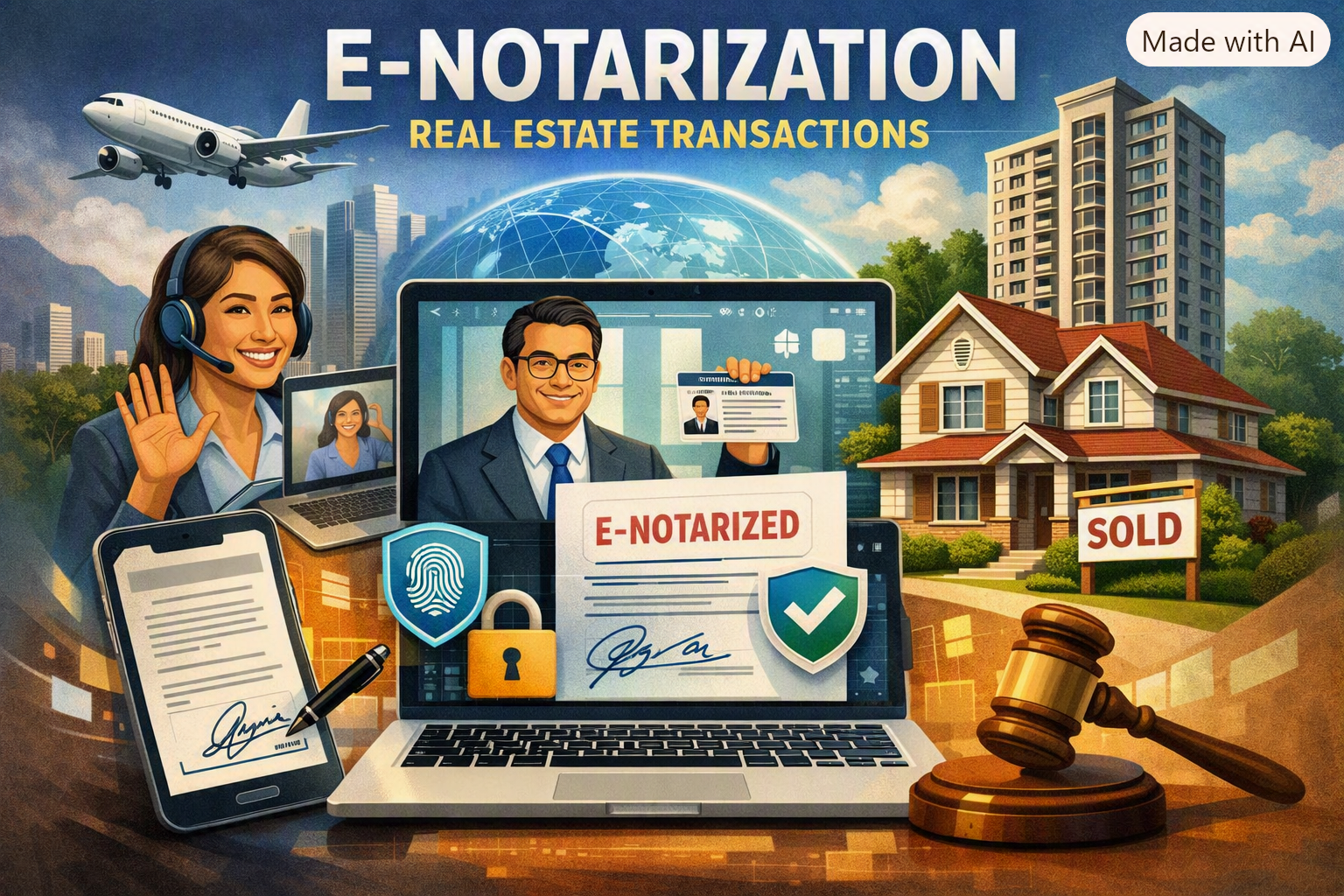
    An illustration depicting e-notarization for real estate transactions, featuring a woman with a headset, a man on a computer screen, various digital documents, a smartphone, a padlock symbol, and a house with a 'SOLD' sign in the background.

    What is E‑Notarization?

    E‑notarization refers to the process of notarizing documents electronically, using secure platforms that allow identity verification, digital signatures, and video conferencing. In the Philippines, the Supreme Court has issued rules enabling notaries public to perform notarization remotely, provided strict safeguards are followed.

    Key features include:

    • Video conferencing between the notary public and the client.
    • Digital identity verification (government IDs, biometrics).
    • Electronic signatures compliant with the E‑Commerce Act (Rep. Act No. 8792).
    • Secure archiving of notarized documents.

    Impact on RESPs

    ✅ Advantages

    1. Expanded Reach: Electronic Notaries Public can serve signatories throughout the Philippines and, subject to the Rules’ limited foreign-post exception, signatories abroad. This can help brokers coordinate document execution for clients in different locations.
    2. Efficiency in Transactions: Deeds, contracts, and SPAs can be notarized faster, reducing delays in property transfers and financing.
    3. Professional Modernization: Practitioners who adopt e‑notarization demonstrate digital competence, positioning themselves as forward‑thinking professionals.

    ⚠️ Challenges

    1. Compliance Burden: Practitioners must strictly follow Supreme Court guidelines, including secure video conferencing, identity verification, and digital archiving. Any lapse can invalidate the notarization.
    2. Technology Costs: Investment in secure platforms, e‑signatures, and cybersecurity measures is necessary. Smaller law firms may struggle with the financial burden. This may increase the total cost for notarization of the document.
    3. Recognition Issues: Some registries, banks, and government agencies may still prefer traditional notarization, creating transitional challenges.
    4. Training and Adaptation: Notaries and staff must be trained to handle digital tools and ensure compliance with evolving rules.

    ⚠️ Disclaimer

    Personally, I have not applied to become an electronic Notary Public at this time. Why? In my mind, the administrative compliance is too much for a small law firm’s operation. I am currently a Notary Public for the City of Muntinlupa. The current administrative compliance our staff goes through every single month is quite overwhelming. Therefore, I do not wish to put an additional burden on the staff at this time. E-notarization is a good concept, but I would let other legal practitioners handle this and remain content as a regular Notary Public.

    Impact on OFWs and Local Buyers

    ✅ Advantages

    1. No Travel to a Notary’s Office: Buyers physically located anywhere within the Philippines can complete notarization remotely, eliminating the need to travel to a notary’s office regardless of distance.
    2. Convenience for OFWs Back Home: OFWs who have returned to the Philippines on vacation or for good can sign documents without visiting a physical office, saving time and travel during their limited stay.
    3. Faster Processing: No need to schedule in-person appointments or coordinate travel. Documents can be notarized promptly via video conference, speeding up property acquisitions and financing approvals.
    4. Accessibility for Provincial Buyers: Buyers located in provinces far from notary offices gain easier access to notarization services, encouraging broader participation in the property market across the country, provided that proper and adequate legal due diligence on the real estate has been conducted.

    ⚠️ Risks

    1. Jurisdictional Recognition: Not all institutions (banks, registries, courts) may immediately accept e‑notarized documents. Buyers must confirm acceptance before proceeding.
    2. Cybersecurity Concerns: Sensitive personal and financial data must be protected against hacking or fraud in compliance with the Data Privacy Act of 2012.
    3. Digital Literacy Barriers: Overseas clients unfamiliar with digital tools may face difficulty navigating the process.
    4. Dependence on Internet Stability: Poor connectivity can disrupt video conferencing and delay notarization.

    📌 Practical Takeaways

    • For RESPs: Ask around to determine who has been approved by the Supreme Court as an electronic notary public.
    • For Buyers Abroad: Confirm with the relevant Philippine foreign post and a commissioned Electronic Notary Public whether the overseas procedure is available. Also confirm the receiving bank, Registry of Deeds, or government agency’s applicable submission and verification requirements.
    • For Both Parties: Prioritize cybersecurity and authenticity checks to prevent fraud. RESPs should keep in mind the “Know Your Client” protocols for clients abroad pursuant to the rules and regulations of the Anti-Money Laundering Council.

    📊 Case Scenarios

    Scenario 1: OFW Buying a Condo

    Maria is an OFW who has returned to the Philippines on vacation. She needs to sign an SPA so her brother can execute the deed of sale on her behalf for a house and lot in Gen. Trias City, Cavite. The problem: Maria is in her home province of Iloilo, while the notary public is in Manila. With e‑notarization, Maria can complete the entire process remotely from Iloilo — without purchasing a plane ticket to Manila — as long as both she and the notary are physically within the Philippines.

    Scenario 2: Broker Handling Overseas Client

    Juan, a licensed REB based in Metro Manila, assists a balikbayan client who has recently returned to the Philippines and is staying in Davao. The client needs to sign loan documents, but traveling to Manila is costly and time-consuming. Using e‑notarization, Juan and his client finalize the documents remotely — without either party traveling — closing the deal faster and enhancing Juan’s reputation as a tech‑savvy professional.

    🔐 Safeguards and Best Practices

    • Identity Verification: Always use government‑issued IDs and biometric checks.
    • Secure Platforms: Choose Supreme Court‑accredited e‑notarization systems.
    • Data Protection: Encrypt all communications and archives.
    • Client Education: Guide overseas buyers through the digital process to reduce confusion.

    ✍️ Conclusion

    E‑notarization is a game‑changer for Philippine real estate transactions. It bridges geographic distances within the Philippines — connecting RESPs and their clients across provinces and regions without the burden of travel. Yet, it also demands vigilance in compliance, recognition, and security.

    For RESPs, early adoption and understanding mean positioning themselves as trusted advisors in the digital era. For buyers in the Philippines, e-notarization can reduce travel to a notary’s office. For eligible signatories abroad, the limited foreign-post procedure offers another possible route, subject to the required attendance, verification, and safeguards.

    📣 Call to Action

    If you’re a licensed REB, now is the time to think about e‑notarization. Determine whether it will be advantageous or not to your clients — particularly those located in provinces or remote areas who stand to benefit most.

    If you are buying property, ask your licensed real estate broker or real estate attorney which notarization route fits your location and documents. If you are abroad, check the foreign-post procedure described above. Then confirm service availability and the receiving institution’s requirements before making arrangements.

    👉 Stay ahead of the curve. The future of real estate transactions in the Philippines is digital — and e‑notarization may lead the way, bringing notarial services closer to every Filipino, wherever they are in the country.

    ——-

    Atty. Jojo is a real estate attorney, an estate planning attorney, a licensed real estate broker, and a PRC-accredited Lecturer/ Speaker for Training Programs in Real Estate. He is committed to helping new and veteran real estate service practitioners be well-informed about the latest laws, rules, regulations, and information relevant to the real estate service sector.

  • Protecting Broker Commission from a Scheming Landowner

    Protecting Broker Commission from a Scheming Landowner

    “It is important to have a written agreement executed by the property owner that contains all the significant provisions that will protect us practitioners in the event of litigation”

    – Atty. Ernesto C. Perez II, CTEP


    By Realttorney

    Imagine this: you’ve done the hard work. You’ve introduced a buyer to a bank, facilitated negotiations, and even seen an offer worth millions placed on the table. Then, suddenly, the deal stalls. Months later, you discover the same buyer and the bank have gone behind closed doors, relabeled the transaction, and moved forward without you. Your commission? Gone — or so they hope.

    A professional legal/real estate themed image showing a detailed contract or legal document on a desk, with a magnifying glass placed over key text, dramatic lighting, dark navy and gold tones, ultra-realistic photography style

    That’s exactly what happened in Bayanin v. Philippine National Bank (2023), a case every licensed real estate broker and salesperson should know by heart.

    The Story Behind the Case

    Minerva Bayanin and Eden Cruz, both accredited brokers with PNB, connected Avida Land Corporation to the bank for the purchase of prime lots along EDSA in Mandaluyong. Avida even placed a ₱40 million offer. But when the transaction stalled, PNB and Avida shifted gears — entering into what they called a “joint venture” instead of a sale.

    The brokers were cut out of the loop. No updates, no access, no commission.

    But here’s the twist: the so-called “joint venture” wasn’t what it seemed. The Supreme Court later confirmed that the MOA and Deed of Conveyance between PNB and Avida had all the hallmarks of a sale — consent, a determinate subject matter, and a price certain in money. In fact, PNB itself declared ₱1.399 billion as the “Selling Price” in its tax filings.

    Why This Matters to You

    The Bayanin case is more than a victory for two brokers. It’s a warning and a lesson rolled into one:

    1. Warning: Institutional sellers (banks, corporations, real estate developers) have the sophistication to relabel transactions. They can call a sale a “joint venture,” a “development agreement,” or anything else to obscure your role.

    1. Lesson: Courts will look past the label to the substance. But you can’t rely on litigation alone. The real protection lies in documenting your role early and clearly: who you introduced, when, and how. That paper trail is your shield when the label starts to lie.

    As the Supreme Court put it: “A contract is what the law defines it to be based on its essential elements, not what the parties choose to call it.”

    The Takeaway

    For REBs and RESs, Bayanin v. PNB is a modern reminder that your commission lives in the substance of the deal, not the title of the paperwork. Owners may try to delay or deny, but the law recognizes the broker’s indispensable role as the procuring cause.

    The challenge is not just winning in court. It is preventing years of litigation by protecting yourself upfront. That means meticulous documentation, airtight agreements, and vigilance when dealing with institutional sellers.

    Protect Your Commission Before It’s Too Late

    This case is just one example of the tactics brokers face in the field. If you want to safeguard your livelihood, you need more than case law. You need practical strategies.

    That’s why I wrote my upcoming eBook, “Protecting Your Commission.” In 44 pages, it distills decades of experience and landmark jurisprudence into actionable steps you can apply immediately. However, pending the application for an ISBN, I cannot sell it at this moment.

    In the meantime, I hope you will read carefully the case digest that I dutifully prepared for you while waiting for the official release of the eBook. The investment fee for the eBook is ₱499.00. Let me know if you wish to get a glimpse of the book cover, table of contents, and one of the eight (8) chapters of the eBook. Comment below.

    ——-

    Atty. Jojo is a real estate attorney, an estate planning attorney, a licensed real estate broker, and a PRC-accredited Lecturer/ Speaker for Training Programs in Real Estate. He is committed to helping new and veteran real estate service practitioners to be well-informed about the latest laws, rules, regulations, and information relevant to the real estate service sector.

  • Keeping the Human Advantage: Real Estate Brokerage in the Philippines and AI

    Keeping the Human Advantage: Real Estate Brokerage in the Philippines and AI

    “AI can give answers. People give purpose. In Philippine real estate, purpose preserves value.”

    – Ernesto C. Perez II, CTEP, REB, Real Estate Attorney & Author

    By Realttorney®

    Simon Sinek’s recent warnings about AI are not anti-technology. They are a call to defend the human processes that cultivate judgment, trust, and purpose. For Philippine real estate professionals (lawyers, brokers, salespersons, appraisers, and allied advisers), the strategic response is threefold: (1) automate routine tasks but never outsource formation of judgment, (2) productize and charge for human-only services, and (3) deploy AI under strict human-in-the-loop, privacy, and ethical safeguards. This article provides implementation guidance, Philippine case examples, and templates for publication and compliance.

    The problem Simon Sinek warns about. Why it matters

    In his recent interview by Simon Squibb posted on YouTube, Simon Sinek sounded a clear alarm: artificial intelligence will rapidly absorb routine tasks and produce high-quality outputs, and in doing so, it risks eroding the very processes — the struggle, practice, and imperfect learning — that build human judgment, empathy, and trust. The result, he warns, could be a society and economy with excellent answers but diminished human connection.

    For Philippine real estate service practitioners (RESPs), this is no longer a theoretical debate. The local market is already being reshaped by Proptech platforms, AI-powered listing search and match functions, and new AI concierge apps that promise faster, cheaper customer journeys.

    The strategic question for veteran and novice RESPs alike is simple: how do we use AI’s strengths while preserving and amplifying the uniquely human skills buyers and sellers still (and will always) pay for — judgment, relationships, stewardship, and ethical responsibility?

    Furthermore, recent regulatory guidelines make it clear that deploying AI in commercial services is not a legal free-for-all. The principles attached to privacy, transparency, and contractual safeguards all matter.

    This article translates Sinek’s core message into concrete, role-specific guidance for the Philippine context, with practical steps, and short case examples from the local market. This is an update of the first article that I wrote about artificial intelligence, published on April 20, 2023, entitled “Redefining Real Estate: How Brokers Can Leverage AI to Elevate Their Business.”

    Current Philippine Landscape: Speed of Adoption and Regulatory Guardrails

    Proptech marketplaces (Lamudi, Carousell/Property24, and other local portals) and AI-enabled property platforms are active in the Philippines. They remain major gateways for buyers and sellers and already use automated search, chatbots, and analytics to improve matching during search inquiries. In May 2025, an Inquirer Business article featured the launch of an AI-powered real estate concierge app in the Philippines that is designed to serve property buyers, owners, brokers, and global investors.

    These tools accelerate the front end (lead generation, matching, initial Q&A) but do not replace legal title checks, fiduciary advice, or complex negotiations. The National Privacy Commission’s (NPC) advisory clarifies that the Data Privacy Act of 2012 and other regulations apply to AI systems that process personal data. These firms must embed in their platform the guidelines on transparency, consent, lawful basis, and protection of the rights of the subject.

    The Core Thesis: Double Down on the Human Advantage

    AI will win on speed, pattern-matching, and commoditized outputs. Human professionals must win on purpose, empathy, ethical judgment, and long-term stewardship. Practically, this means:

    1. Stop competing with machines at their game (raw speed or generic outputs).

    2. Productize and charge for what only humans can do: dispute navigation, legacy planning, nuanced negotiation, and trust-based advisory.

    3. Use AI to remove friction (collecting and sorting data, document drafting, repetitive tasks) and free time to deepen human relationships.

    4. Deploy AI under strict human-in-the-loop, privacy and ethical safeguards.

    The Veteran REBs’ Takeaway

    Veteran real estate brokers possess deep experiential capital — the negotiation instincts, accumulated judgment, reputational integrity, and established networks that matter most to clients. Sinek’s counsel to “defend the struggle” means deliberately preserving these activities that sharpen interpersonal skills.

    What are the strategic moves that the veteran REBs must make at this time? As a professional who has studied, consumed a lot of information, and lectured about AI and its effect on the real estate service sector for more than two years now, here are my humble suggestions:

    1. Reposition from “transactional agent” to “trusted steward”. Offer explicit advisory packages for things the market cannot automate, like legacy transfers, legal due diligence on land titles, tax-efficient structuring of real estate holdings, and asset preservation workshops. These are services where decades of knowledge, experience, and judgment matter.

    2. Productize judgment and expertise. Create billable advisory “blocks” (e.g., Effective Estate Transfer Roadmap, Identifying Fake Land Titles and Other Risk Assessment, Post-sale Conflict Management, etc.) with clear deliverables and fees so clients understand they are paying for human expertise, not just administrative work.

    3. Delegate automation, but guard learning. Use AI to draft non-substantive documents, summarize market surveys, or triage leads — but require human review for any client-facing legal advice, negotiation strategies, or final documents. Institutionalize a human-in-the-loop (HITL) policy.

    4. Adopt “human-first” client experience. Combine AI triage (automated listing matches, initial KYC) with mandatory human touchpoints for decision events: negotiation, contract signing, and referral to a real estate attorney.

    The Real Estate Newbies’ Takeaway

    New entrants must learn faster than ever, but not outsource their learning to AI. Sinek warns that when AI supplies perfected outputs, people can stop learning the processes that build competence.

    Immerse yourself in the “grind” of doing the mundane and the basics. Learn everything about our profession and its best practices. Then, understand where to implement the following strategic moves in your daily or weekly workflow:

    1. Use AI as training wheels — not a substitute. Employ AI for research and draft generation of market summaries and marketing copy. But always review, examine, and evaluate the output. Fact-check, if necessary. However, always: (a) pre-write your negotiation scripts by hand, (b) role-play negotiations with mentors, and (c) write debrief notes to retain learning.

    2. Practice “muscle memory” through role-play. Real negotiation skill develops in messy, imperfect practice. Schedule daily/weekly role plays with mentors and record the entire exchange. Then upload it to your favorite AI platform and ask how you can do better at negotiating or generating leads.

    3. Build a distinctive ‘Why’. A clear niche and purpose accelerate differentiation (e.g., “I help OFWs protect inherited properties from double sale and title fraud”). Purpose guides content, referrals, and how you price human advisory services.

    4. Create Your Brand. As a newbie, the main question to answer is: why would a prospective client choose you over a veteran real estate broker? What sets you apart or makes you different from other licensed real estate brokers with years of experience? In other words, develop, create, or fashion your unique selling proposition. Then, make your vision and mission statement, and list the values you want to be known for. Use AI for this very important exercise/task.

    Rules of Engagement with AI

    At this point, we must create a framework that should be implemented when the RESP interacts with AI. These are the elements of the framework:

    1. Human-in-the-loop (HITL): Any AI output that influences a client decision or legal document must be reviewed by the licensed professional.

    2. Transparency & consent: Disclose to clients when AI was used in producing advice or documents. Moreover, it is highly important to obtain consent when processing personal data. NPC guidance and advisories make these obligations non-optional for personal data processing.

    3. Contractual safeguards for data gathering: Legal commentary and law firm primers emphasize contractual safeguards for AI deployments to assure data privacy. The RESP must learn and understand warranties, data-use limitations, and audit rights in contracts (data residency, deletion rights, no training on client data without consent).

    4. Measure what matters: Track Net Promoter Score (NPS), dispute frequency, and time-to-close and repeat referrals, and client retention for human touchpoints — not only volume of automated touches. Use these Key Performance Indicators (KPIs) to justify the cost of preserving human interactions.

    Ethical and Regulatory Considerations

    The NPC’s AI guidance and related advisories apply where personal data is processed by AI (training, testing, deployment). That means licensed real estate brokers and salespersons must treat AI deployments under existing data-privacy rules: provide transparency, ensure data minimization, and permit human intervention in automated decision-making. Failure to do so exposes the RESP to regulatory and reputational risk.

    The use of AI should also be implemented in conjunction with our compliance with PRBRES Resolution No. 39, Series of 2019 [The Code of Ethics and Responsibilities for Real Estate Service Practitioners], as well as other AI Governance Frameworks that will be issued in the coming years. The ethical use of AI in the real estate services sector is still a work in progress.

    In conclusion, Simon Sinek’s message is neither Luddite panic nor techno-optimism. It’s a call to preserve the human processes that produce true professional judgment. In the Philippines, where family, legacy, personal trust, and integrity drive many real property decisions, the professional who can blend efficient AI tools with deliberate human stewardship will not only survive but thrive. Measure success in client outcomes and relationships — not in how many repetitive tasks you automated.

    So, are you ready to fully embrace AI and integrate it into your practice? Tell us your fears and apprehensions about AI. Or share with us three concrete steps you will take in the next 90 days to grow your practice using AI.

    Sources and Further Reading:

    1. Simon Sinek — You’re Being Lied To About AI’s Real Purpose (YouTube). YouTube
      https://www.youtube.com/watch?v=W2a_adkjqiA
    2. National Privacy Commission — Advisory / Guidelines on AI systems and DPA application (NPC). National Privacy Commission
      https://privacy.gov.ph/wp-content/uploads/2025/02/Advisory-2024.12.19-Guidelines-on-Artificial-Intelligence-w-SGD.pdf
    3. Quisumbing Torres — Deploying AI in the Philippines? 10 things you need to know (legal primer). Quisumbing Torres
      https://www.quisumbingtorres.com/en/newsroom/2025/deploying-ai-in-the-philippines
    4. Philstar — AI-powered buying, selling, renting property app launched (Nov 14, 2024). Philstar
      https://www.philstar.com/lifestyle/gadgets/2024/11/14/2399831/ai-powered-buying-selling-renting-property-app-launched
    5. Inquirer Business — NoneAway officially launches AI Concierge (May 15, 2025). Inquirer Business
      https://business.inquirer.net/525591/noneaway-officially-launches-ai-concierge-the-first-ai-powered-real-estate-app-in-the-philippines-for-buyers-owners-brokers-and-global-investors
    6. Lamudi Philippines — Proptech & features commentary (Lamudi Journal). Lamudi Philippines
      https://www.lamudi.com.ph/journal/nothing-fear-about-emerging-proptech/

    Atty. Ernesto C. Perez II, CTEP, REB, [Realttorney]. Licensed for reuse under CC BY-NC with attribution. For permissions and consultancy, visit realttorney.com/contact.

    ——-

    Atty. Jojo Perez is a real estate attorney, an estate planning attorney, a licensed real estate broker (since 2009), and a PRC-accredited Lecturer/ Speaker for Training Programs in Real Estate (since 2013). He is committed to helping new and veteran real estate service practitioners be well-informed of the latest laws, rules, regulations, and information relevant to the real estate service sector.