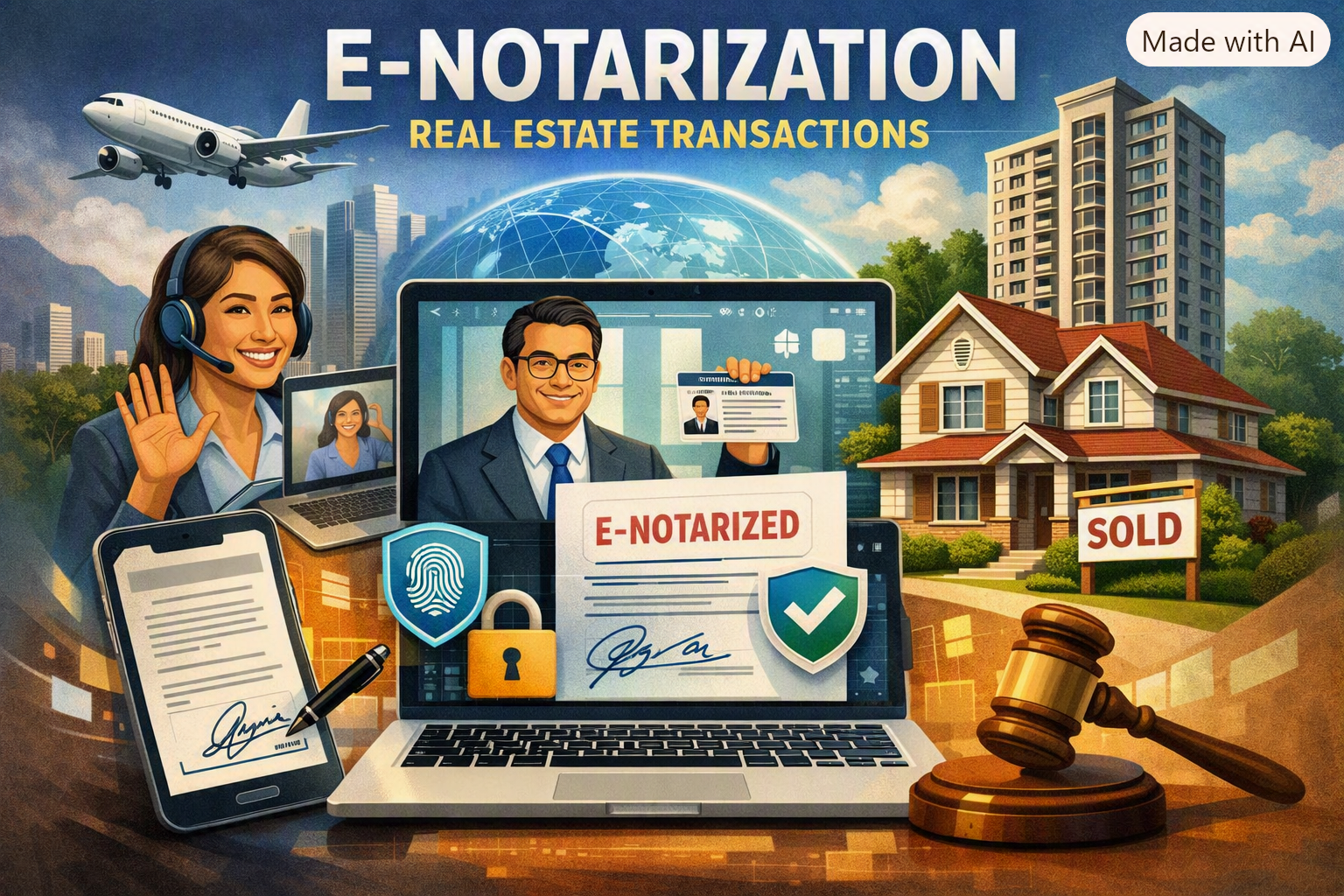
“The E-Notarization addresses a key limitation of the 2004 Notarial Rules, where traditional notaries public were restricted to performing notarizations only within their territorial jurisdiction.”
– Supreme Court of the Philippines
By Realttorney
Introduction: The Digital Shift in Real Estate
Imagine this: You’re an Overseas Filipino Worker (OFW) who has finally returned home to the Philippines on vacation. You need to sign a Special Power of Attorney (SPA) so your sibling can act on your behalf in a property transaction — but you’re in your home province, and the notary public is in a city hours away. Traditionally, this meant booking a bus or flight, taking time out of your vacation, and spending money to appear before a notary.
Now, with e‑notarization, you can complete the process online — securely, legally, and without leaving your province. Under the Supreme Court’s Rules on Electronic Notarization (A.M. No. 24-10-14-SC), remote electronic notarization generally requires the participants to be within the Philippines.
However, Rule IV, Section 5 allows a limited exception for a signatory abroad who is physically present at a Philippine embassy, Philippine consular office, or office of a Philippine Honorary Consul. The electronic notary must remain in the Philippines, verify the signatory’s location through video, and obtain confirmation of the signatory’s presence from the designated officer at the foreign post. This does not permit an overseas signatory to participate from just any location, such as a home or office. Availability must be confirmed with the relevant foreign post and electronic notary, and all other requirements of the Rules must be satisfied.

What is E‑Notarization?
E‑notarization refers to the process of notarizing documents electronically, using secure platforms that allow identity verification, digital signatures, and video conferencing. In the Philippines, the Supreme Court has issued rules enabling notaries public to perform notarization remotely, provided strict safeguards are followed.
Key features include:
- Video conferencing between the notary public and the client.
- Digital identity verification (government IDs, biometrics).
- Electronic signatures compliant with the E‑Commerce Act (Rep. Act No. 8792).
- Secure archiving of notarized documents.
Impact on RESPs
✅ Advantages
- Expanded Reach: Electronic Notaries Public can serve signatories throughout the Philippines and, subject to the Rules’ limited foreign-post exception, signatories abroad. This can help brokers coordinate document execution for clients in different locations.
- Efficiency in Transactions: Deeds, contracts, and SPAs can be notarized faster, reducing delays in property transfers and financing.
- Professional Modernization: Practitioners who adopt e‑notarization demonstrate digital competence, positioning themselves as forward‑thinking professionals.
⚠️ Challenges
- Compliance Burden: Practitioners must strictly follow Supreme Court guidelines, including secure video conferencing, identity verification, and digital archiving. Any lapse can invalidate the notarization.
- Technology Costs: Investment in secure platforms, e‑signatures, and cybersecurity measures is necessary. Smaller law firms may struggle with the financial burden. This may increase the total cost for notarization of the document.
- Recognition Issues: Some registries, banks, and government agencies may still prefer traditional notarization, creating transitional challenges.
- Training and Adaptation: Notaries and staff must be trained to handle digital tools and ensure compliance with evolving rules.
⚠️ Disclaimer
Personally, I have not applied to become an electronic Notary Public at this time. Why? In my mind, the administrative compliance is too much for a small law firm’s operation. I am currently a Notary Public for the City of Muntinlupa. The current administrative compliance our staff goes through every single month is quite overwhelming. Therefore, I do not wish to put an additional burden on the staff at this time. E-notarization is a good concept, but I would let other legal practitioners handle this and remain content as a regular Notary Public.
Impact on OFWs and Local Buyers
✅ Advantages
- No Travel to a Notary’s Office: Buyers physically located anywhere within the Philippines can complete notarization remotely, eliminating the need to travel to a notary’s office regardless of distance.
- Convenience for OFWs Back Home: OFWs who have returned to the Philippines on vacation or for good can sign documents without visiting a physical office, saving time and travel during their limited stay.
- Faster Processing: No need to schedule in-person appointments or coordinate travel. Documents can be notarized promptly via video conference, speeding up property acquisitions and financing approvals.
- Accessibility for Provincial Buyers: Buyers located in provinces far from notary offices gain easier access to notarization services, encouraging broader participation in the property market across the country, provided that proper and adequate legal due diligence on the real estate has been conducted.
⚠️ Risks
- Jurisdictional Recognition: Not all institutions (banks, registries, courts) may immediately accept e‑notarized documents. Buyers must confirm acceptance before proceeding.
- Cybersecurity Concerns: Sensitive personal and financial data must be protected against hacking or fraud in compliance with the Data Privacy Act of 2012.
- Digital Literacy Barriers: Overseas clients unfamiliar with digital tools may face difficulty navigating the process.
- Dependence on Internet Stability: Poor connectivity can disrupt video conferencing and delay notarization.
📌 Practical Takeaways
- For RESPs: Ask around to determine who has been approved by the Supreme Court as an electronic notary public.
- For Buyers Abroad: Confirm with the relevant Philippine foreign post and a commissioned Electronic Notary Public whether the overseas procedure is available. Also confirm the receiving bank, Registry of Deeds, or government agency’s applicable submission and verification requirements.
- For Both Parties: Prioritize cybersecurity and authenticity checks to prevent fraud. RESPs should keep in mind the “Know Your Client” protocols for clients abroad pursuant to the rules and regulations of the Anti-Money Laundering Council.
📊 Case Scenarios
Scenario 1: OFW Buying a Condo
Maria is an OFW who has returned to the Philippines on vacation. She needs to sign an SPA so her brother can execute the deed of sale on her behalf for a house and lot in Gen. Trias City, Cavite. The problem: Maria is in her home province of Iloilo, while the notary public is in Manila. With e‑notarization, Maria can complete the entire process remotely from Iloilo — without purchasing a plane ticket to Manila — as long as both she and the notary are physically within the Philippines.
Scenario 2: Broker Handling Overseas Client
Juan, a licensed REB based in Metro Manila, assists a balikbayan client who has recently returned to the Philippines and is staying in Davao. The client needs to sign loan documents, but traveling to Manila is costly and time-consuming. Using e‑notarization, Juan and his client finalize the documents remotely — without either party traveling — closing the deal faster and enhancing Juan’s reputation as a tech‑savvy professional.
🔐 Safeguards and Best Practices
- Identity Verification: Always use government‑issued IDs and biometric checks.
- Secure Platforms: Choose Supreme Court‑accredited e‑notarization systems.
- Data Protection: Encrypt all communications and archives.
- Client Education: Guide overseas buyers through the digital process to reduce confusion.
✍️ Conclusion
E‑notarization is a game‑changer for Philippine real estate transactions. It bridges geographic distances within the Philippines — connecting RESPs and their clients across provinces and regions without the burden of travel. Yet, it also demands vigilance in compliance, recognition, and security.
For RESPs, early adoption and understanding mean positioning themselves as trusted advisors in the digital era. For buyers in the Philippines, e-notarization can reduce travel to a notary’s office. For eligible signatories abroad, the limited foreign-post procedure offers another possible route, subject to the required attendance, verification, and safeguards.
📣 Call to Action
If you’re a licensed REB, now is the time to think about e‑notarization. Determine whether it will be advantageous or not to your clients — particularly those located in provinces or remote areas who stand to benefit most.
If you are buying property, ask your licensed real estate broker or real estate attorney which notarization route fits your location and documents. If you are abroad, check the foreign-post procedure described above. Then confirm service availability and the receiving institution’s requirements before making arrangements.
👉 Stay ahead of the curve. The future of real estate transactions in the Philippines is digital — and e‑notarization may lead the way, bringing notarial services closer to every Filipino, wherever they are in the country.
——-
Atty. Jojo is a real estate attorney, an estate planning attorney, a licensed real estate broker, and a PRC-accredited Lecturer/ Speaker for Training Programs in Real Estate. He is committed to helping new and veteran real estate service practitioners be well-informed about the latest laws, rules, regulations, and information relevant to the real estate service sector.