
Tag: real estate service practitioners

  • When a Co-Heir Refuses to Sign: What You Can Do

    When a Co-Heir Refuses to Sign: What You Can Do

    “No co-owner shall be obliged to remain in the co-ownership.”

    Civil Code, Art. 494
    Family members reviewing property documents at a table with one empty chair, illustrating a co-heir who refuses to sign.

    By Realttorney®

    This is the second article in our November series on estate settlement. Read the first: How to Sell the Property of a Dead Relative in the Philippines.

    When one heir refuses to sign, the other heirs cannot lawfully sell the whole property or sign for the holdout. They may sell only their own shares, or ask a court to partition the estate or, if the property cannot be divided, to order its sale. Bypassing the holdout puts the entire deal at risk.

    Why does one heir’s signature matter?

    Rights to a succession pass to the heirs from the moment of death (Civil Code, Art. 777). With two or more heirs, the estate is owned in common before partition, subject to the decedent’s debts (Art. 1078). Each heir owns an undivided share, not a particular corner of the lot.

    An extrajudicial settlement is the out-of-court way to divide an estate. Rule 74, Section 1 of the Rules of Court allows it only if the decedent left no will and no debts, and the heirs are all of age or the minors are duly represented. It is done by public instrument filed with the Registry of Deeds. The same section says no extrajudicial settlement binds anyone who did not participate in it or had no notice of it.

    Can the other heirs sell without the holdout?

    Only their own shares. A co-owner may sell her part, but the sale affects only the portion allotted to her when the co-ownership ends (Art. 493). In Neri v. Heirs of Uy (G.R. No. 194366, October 10, 2012), the Supreme Court held that the signing heirs could sell only their proportionate shares, and the buyers became co-owners with the heirs who were left out.

    In our practice as licensed real estate brokers or accredited real estate salespersons, a share-only purchase is a hard market for buyers and lenders who want the entirety of the lot with a clean title.

    If an heir sells his hereditary rights to a stranger before partition, the co-heirs, including the holdout, may take the buyer’s place by reimbursing the price within one month from written notice of the sale (Art. 1088).

    What if the others sign anyway and leave the holdout out?

    The extrajudicial settlement is void as to the preterited heir. Neri case, quoting Segura v. Segura (G.R. No. L-29320, September 19, 1988), calls an extrajudicial settlement that omits an heir a total nullity as to that preterited heir. The Court also held that the two-year period did not apply to heirs deprived of their lawful share. Remember, the general rule is that no one can give what he does not have.

    Hence, even if the buyer purchased the entire lot by virtue of the extrajudicial settlement of estate signed by the heirs in agreement (less the excluded heir), the former became the owner of the portion that was validly sold to him. The rest of the property is still owned by the preterited heir.

    In effect, the buyer became a pro indiviso co-owner with the excluded heirs, and holds the share of the excluded heir under an implied trust. Hence, an action for reconveyance of property held in implied trust does not prescribe.

    However, this is true only as long as the trustee continues to acknowledge the title of the cestui que trust, or stated otherwise, provided she does not repudiate such title.

    The moment she does so, the prescriptive period will begin to run and may eventually operate to divest the real owners of their right to the property after the lapse of the applicable statutory period. Hence, an action to recover the property held in trust (an obligation created by law) prescribes in ten years, counted from the actual date of repudiation (the registration of a new Torrens title under a new owner).

    In plain terms: the excluded heir has the right to claim her share, provided she acts swiftly to force the seller to return the price for that share or portion of the property. But, in the hands of a buyer in good faith and for value, the excluded heir may not unravel the deal years later, if she slept on her rights.

    What is the two-year period in Section 4, Rule 74?

    If, within two years after settlement and distribution, an heir or other person appears to have been unduly deprived of her lawful share, she may compel the settlement of the estate in court. The heir’s bond and the real estate stay charged with liability for those two years, even after transfers. Section 5 gives a minor, an incapacitated person, or one in prison or outside the Philippines one more year after the disability ends.

    What can the other heirs lawfully do?

    • Negotiate. Learn why the heir refuses: price, mistrust, or unpaid debts. A buy-out of her share can end many standoffs. This is opinion, not law.
    • File an ordinary action for partition. Rule 74, Section 1 provides that heirs who disagree may proceed this way, and Art. 494 lets any co-owner demand partition at any time as to his share. Partition is by agreement or by judicial proceedings (Art. 496).
    • Ask for a sale if the property cannot be divided. When it is essentially indivisible, and the co-owners cannot agree on who takes it and pays the others, it is sold and the proceeds distributed (Art. 498). Reyes v. Concepcion (G.R. No. 56550, October 1, 1990) upheld a public sale, and Aguilar v. Court of Appeals (G.R. No. 76351, October 29, 1993) held that either co-owner may demand a sale and the other cannot object. Both cases involved ordinary co-owners, not an estate. Hence, applying them to heirs, who are co-owners before partition under Art. 1078, is our interpretation.
    • Go to court if there is a will or a debt. Rule 74, Section 1 then does not apply, and an administrator may sell estate real property only with court authority (Rule 89).

    A hypothetical case

    Ana, Ben, and Carla inherited a titled parcel of land with no will and no debts. Ana and Ben have a buyer. Carla, who lives abroad, thinks the price is too low. If Ana and Ben sell without her, the settlement is void as to Carla. The legal and safer paths are: (1) to engage a licensed real estate appraiser to get the latest market value; (2) propose a buy-out of her share based on the appraised value; or (3) if this fails, file a court action for partition or sale.

    For brokers and salespersons

    Practice tip: Do not market or advertise the whole property nor collect earnest money for a co-owned property until every heir has signed or a court has ruled on the sale. Always secure the full and complete list of heirs, and refer the family to an attorney before lining up a buyer.

    Frequently asked questions

    Can the other heirs sign for the holdout? Not without his authority. A contract in another’s name without authority is unenforceable unless ratified (Arts. 1317 and 1403, as quoted in Neri).

    Can one heir sell his share alone? Yes, but only his share (Art. 493), and the co-heirs may redeem within one month from written notice (Art. 1088).

    Does the two-year period protect a buyer? Not against an excluded heir (Neri case).

    Can a court force the holdout to sell? A court can order partition and, if the property cannot be divided and the heirs cannot agree, a sale with the proceeds distributed (Art. 498). The remedy is a judgment, not his signature.

    Facing a holdout heir? Book a consultation with Realttorney at realttorney.com.


    This article is for general information only and is not legal advice. Consult a lawyer about your specific situation.

    About the Author

    Atty. Jojo Perez is a real estate and estate planning attorney, a licensed real estate broker, and a PRC‑accredited lecturer and speaker on real estate topics. Through Realttorney®, he helps property owners, investors, and real estate professionals understand the legal principles and practical considerations involved in property ownership, foreclosure, and real estate transactions in the Philippines.
  • How E‑Notarization Works in the Philippines for Real Estate Documents

    How E‑Notarization Works in the Philippines for Real Estate Documents

    “The E-Notarization addresses a key limitation of the 2004 Notarial Rules, where traditional notaries public were restricted to performing notarizations only within their territorial jurisdiction.”

    – Supreme Court of the Philippines

    By Realttorney

    Introduction: The Digital Shift in Real Estate

    Imagine this: You’re an Overseas Filipino Worker (OFW) who has finally returned home to the Philippines on vacation. You need to sign a Special Power of Attorney (SPA) so your sibling can act on your behalf in a property transaction — but you’re in your home province, and the notary public is in a city hours away. Traditionally, this meant booking a bus or flight, taking time out of your vacation, and spending money to appear before a notary.

    Now, with e‑notarization, you can complete the process online — securely, legally, and without leaving your province. Under the Supreme Court’s Rules on Electronic Notarization (A.M. No. 24-10-14-SC), remote electronic notarization generally requires the participants to be within the Philippines.

    However, Rule IV, Section 5 allows a limited exception for a signatory abroad who is physically present at a Philippine embassy, Philippine consular office, or office of a Philippine Honorary Consul. The electronic notary must remain in the Philippines, verify the signatory’s location through video, and obtain confirmation of the signatory’s presence from the designated officer at the foreign post. This does not permit an overseas signatory to participate from just any location, such as a home or office. Availability must be confirmed with the relevant foreign post and electronic notary, and all other requirements of the Rules must be satisfied.

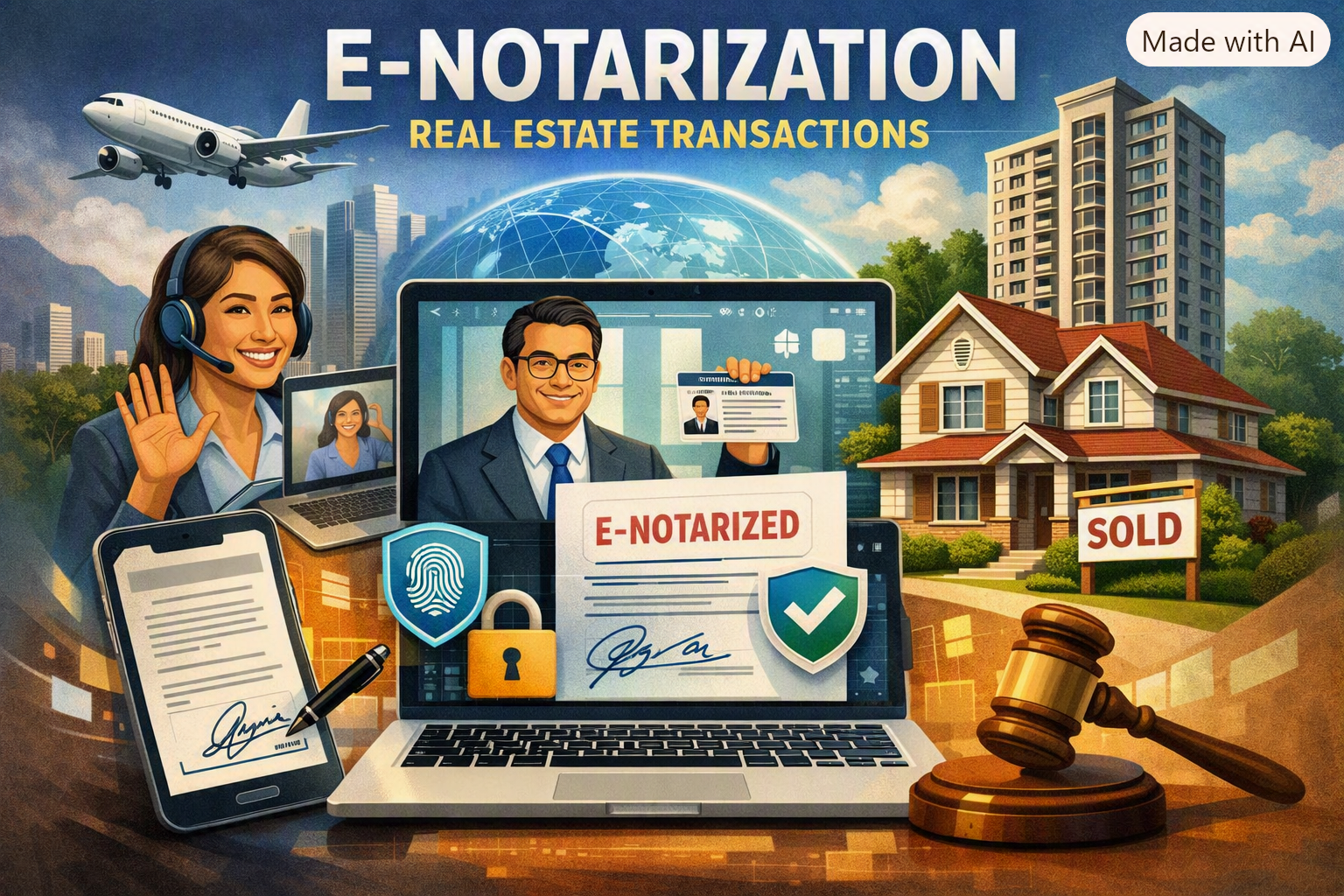
    An illustration depicting e-notarization for real estate transactions, featuring a woman with a headset, a man on a computer screen, various digital documents, a smartphone, a padlock symbol, and a house with a 'SOLD' sign in the background.

    What is E‑Notarization?

    E‑notarization refers to the process of notarizing documents electronically, using secure platforms that allow identity verification, digital signatures, and video conferencing. In the Philippines, the Supreme Court has issued rules enabling notaries public to perform notarization remotely, provided strict safeguards are followed.

    Key features include:

    • Video conferencing between the notary public and the client.
    • Digital identity verification (government IDs, biometrics).
    • Electronic signatures compliant with the E‑Commerce Act (Rep. Act No. 8792).
    • Secure archiving of notarized documents.

    Impact on RESPs

    ✅ Advantages

    1. Expanded Reach: Electronic Notaries Public can serve signatories throughout the Philippines and, subject to the Rules’ limited foreign-post exception, signatories abroad. This can help brokers coordinate document execution for clients in different locations.
    2. Efficiency in Transactions: Deeds, contracts, and SPAs can be notarized faster, reducing delays in property transfers and financing.
    3. Professional Modernization: Practitioners who adopt e‑notarization demonstrate digital competence, positioning themselves as forward‑thinking professionals.

    ⚠️ Challenges

    1. Compliance Burden: Practitioners must strictly follow Supreme Court guidelines, including secure video conferencing, identity verification, and digital archiving. Any lapse can invalidate the notarization.
    2. Technology Costs: Investment in secure platforms, e‑signatures, and cybersecurity measures is necessary. Smaller law firms may struggle with the financial burden. This may increase the total cost for notarization of the document.
    3. Recognition Issues: Some registries, banks, and government agencies may still prefer traditional notarization, creating transitional challenges.
    4. Training and Adaptation: Notaries and staff must be trained to handle digital tools and ensure compliance with evolving rules.

    ⚠️ Disclaimer

    Personally, I have not applied to become an electronic Notary Public at this time. Why? In my mind, the administrative compliance is too much for a small law firm’s operation. I am currently a Notary Public for the City of Muntinlupa. The current administrative compliance our staff goes through every single month is quite overwhelming. Therefore, I do not wish to put an additional burden on the staff at this time. E-notarization is a good concept, but I would let other legal practitioners handle this and remain content as a regular Notary Public.

    Impact on OFWs and Local Buyers

    ✅ Advantages

    1. No Travel to a Notary’s Office: Buyers physically located anywhere within the Philippines can complete notarization remotely, eliminating the need to travel to a notary’s office regardless of distance.
    2. Convenience for OFWs Back Home: OFWs who have returned to the Philippines on vacation or for good can sign documents without visiting a physical office, saving time and travel during their limited stay.
    3. Faster Processing: No need to schedule in-person appointments or coordinate travel. Documents can be notarized promptly via video conference, speeding up property acquisitions and financing approvals.
    4. Accessibility for Provincial Buyers: Buyers located in provinces far from notary offices gain easier access to notarization services, encouraging broader participation in the property market across the country, provided that proper and adequate legal due diligence on the real estate has been conducted.

    ⚠️ Risks

    1. Jurisdictional Recognition: Not all institutions (banks, registries, courts) may immediately accept e‑notarized documents. Buyers must confirm acceptance before proceeding.
    2. Cybersecurity Concerns: Sensitive personal and financial data must be protected against hacking or fraud in compliance with the Data Privacy Act of 2012.
    3. Digital Literacy Barriers: Overseas clients unfamiliar with digital tools may face difficulty navigating the process.
    4. Dependence on Internet Stability: Poor connectivity can disrupt video conferencing and delay notarization.

    📌 Practical Takeaways

    • For RESPs: Ask around to determine who has been approved by the Supreme Court as an electronic notary public.
    • For Buyers Abroad: Confirm with the relevant Philippine foreign post and a commissioned Electronic Notary Public whether the overseas procedure is available. Also confirm the receiving bank, Registry of Deeds, or government agency’s applicable submission and verification requirements.
    • For Both Parties: Prioritize cybersecurity and authenticity checks to prevent fraud. RESPs should keep in mind the “Know Your Client” protocols for clients abroad pursuant to the rules and regulations of the Anti-Money Laundering Council.

    📊 Case Scenarios

    Scenario 1: OFW Buying a Condo

    Maria is an OFW who has returned to the Philippines on vacation. She needs to sign an SPA so her brother can execute the deed of sale on her behalf for a house and lot in Gen. Trias City, Cavite. The problem: Maria is in her home province of Iloilo, while the notary public is in Manila. With e‑notarization, Maria can complete the entire process remotely from Iloilo — without purchasing a plane ticket to Manila — as long as both she and the notary are physically within the Philippines.

    Scenario 2: Broker Handling Overseas Client

    Juan, a licensed REB based in Metro Manila, assists a balikbayan client who has recently returned to the Philippines and is staying in Davao. The client needs to sign loan documents, but traveling to Manila is costly and time-consuming. Using e‑notarization, Juan and his client finalize the documents remotely — without either party traveling — closing the deal faster and enhancing Juan’s reputation as a tech‑savvy professional.

    🔐 Safeguards and Best Practices

    • Identity Verification: Always use government‑issued IDs and biometric checks.
    • Secure Platforms: Choose Supreme Court‑accredited e‑notarization systems.
    • Data Protection: Encrypt all communications and archives.
    • Client Education: Guide overseas buyers through the digital process to reduce confusion.

    ✍️ Conclusion

    E‑notarization is a game‑changer for Philippine real estate transactions. It bridges geographic distances within the Philippines — connecting RESPs and their clients across provinces and regions without the burden of travel. Yet, it also demands vigilance in compliance, recognition, and security.

    For RESPs, early adoption and understanding mean positioning themselves as trusted advisors in the digital era. For buyers in the Philippines, e-notarization can reduce travel to a notary’s office. For eligible signatories abroad, the limited foreign-post procedure offers another possible route, subject to the required attendance, verification, and safeguards.

    📣 Call to Action

    If you’re a licensed REB, now is the time to think about e‑notarization. Determine whether it will be advantageous or not to your clients — particularly those located in provinces or remote areas who stand to benefit most.

    If you are buying property, ask your licensed real estate broker or real estate attorney which notarization route fits your location and documents. If you are abroad, check the foreign-post procedure described above. Then confirm service availability and the receiving institution’s requirements before making arrangements.

    👉 Stay ahead of the curve. The future of real estate transactions in the Philippines is digital — and e‑notarization may lead the way, bringing notarial services closer to every Filipino, wherever they are in the country.

    ——-

    Atty. Jojo is a real estate attorney, an estate planning attorney, a licensed real estate broker, and a PRC-accredited Lecturer/ Speaker for Training Programs in Real Estate. He is committed to helping new and veteran real estate service practitioners be well-informed about the latest laws, rules, regulations, and information relevant to the real estate service sector.

  • Protecting Broker Commission from a Scheming Landowner

    Protecting Broker Commission from a Scheming Landowner

    “It is important to have a written agreement executed by the property owner that contains all the significant provisions that will protect us practitioners in the event of litigation”

    – Atty. Ernesto C. Perez II, CTEP


    By Realttorney

    Imagine this: you’ve done the hard work. You’ve introduced a buyer to a bank, facilitated negotiations, and even seen an offer worth millions placed on the table. Then, suddenly, the deal stalls. Months later, you discover the same buyer and the bank have gone behind closed doors, relabeled the transaction, and moved forward without you. Your commission? Gone — or so they hope.

    A professional legal/real estate themed image showing a detailed contract or legal document on a desk, with a magnifying glass placed over key text, dramatic lighting, dark navy and gold tones, ultra-realistic photography style

    That’s exactly what happened in Bayanin v. Philippine National Bank (2023), a case every licensed real estate broker and salesperson should know by heart.

    The Story Behind the Case

    Minerva Bayanin and Eden Cruz, both accredited brokers with PNB, connected Avida Land Corporation to the bank for the purchase of prime lots along EDSA in Mandaluyong. Avida even placed a ₱40 million offer. But when the transaction stalled, PNB and Avida shifted gears — entering into what they called a “joint venture” instead of a sale.

    The brokers were cut out of the loop. No updates, no access, no commission.

    But here’s the twist: the so-called “joint venture” wasn’t what it seemed. The Supreme Court later confirmed that the MOA and Deed of Conveyance between PNB and Avida had all the hallmarks of a sale — consent, a determinate subject matter, and a price certain in money. In fact, PNB itself declared ₱1.399 billion as the “Selling Price” in its tax filings.

    Why This Matters to You

    The Bayanin case is more than a victory for two brokers. It’s a warning and a lesson rolled into one:

    1. Warning: Institutional sellers (banks, corporations, real estate developers) have the sophistication to relabel transactions. They can call a sale a “joint venture,” a “development agreement,” or anything else to obscure your role.

    1. Lesson: Courts will look past the label to the substance. But you can’t rely on litigation alone. The real protection lies in documenting your role early and clearly: who you introduced, when, and how. That paper trail is your shield when the label starts to lie.

    As the Supreme Court put it: “A contract is what the law defines it to be based on its essential elements, not what the parties choose to call it.”

    The Takeaway

    For REBs and RESs, Bayanin v. PNB is a modern reminder that your commission lives in the substance of the deal, not the title of the paperwork. Owners may try to delay or deny, but the law recognizes the broker’s indispensable role as the procuring cause.

    The challenge is not just winning in court. It is preventing years of litigation by protecting yourself upfront. That means meticulous documentation, airtight agreements, and vigilance when dealing with institutional sellers.

    Protect Your Commission Before It’s Too Late

    This case is just one example of the tactics brokers face in the field. If you want to safeguard your livelihood, you need more than case law. You need practical strategies.

    That’s why I wrote my upcoming eBook, “Protecting Your Commission.” In 44 pages, it distills decades of experience and landmark jurisprudence into actionable steps you can apply immediately. However, pending the application for an ISBN, I cannot sell it at this moment.

    In the meantime, I hope you will read carefully the case digest that I dutifully prepared for you while waiting for the official release of the eBook. The investment fee for the eBook is ₱499.00. Let me know if you wish to get a glimpse of the book cover, table of contents, and one of the eight (8) chapters of the eBook. Comment below.

    ——-

    Atty. Jojo is a real estate attorney, an estate planning attorney, a licensed real estate broker, and a PRC-accredited Lecturer/ Speaker for Training Programs in Real Estate. He is committed to helping new and veteran real estate service practitioners to be well-informed about the latest laws, rules, regulations, and information relevant to the real estate service sector.

  • Keeping the Human Advantage: Real Estate Brokerage in the Philippines and AI

    Keeping the Human Advantage: Real Estate Brokerage in the Philippines and AI

    “AI can give answers. People give purpose. In Philippine real estate, purpose preserves value.”

    – Ernesto C. Perez II, CTEP, REB, Real Estate Attorney & Author

    By Realttorney®

    Simon Sinek’s recent warnings about AI are not anti-technology. They are a call to defend the human processes that cultivate judgment, trust, and purpose. For Philippine real estate professionals (lawyers, brokers, salespersons, appraisers, and allied advisers), the strategic response is threefold: (1) automate routine tasks but never outsource formation of judgment, (2) productize and charge for human-only services, and (3) deploy AI under strict human-in-the-loop, privacy, and ethical safeguards. This article provides implementation guidance, Philippine case examples, and templates for publication and compliance.

    The problem Simon Sinek warns about. Why it matters

    In his recent interview by Simon Squibb posted on YouTube, Simon Sinek sounded a clear alarm: artificial intelligence will rapidly absorb routine tasks and produce high-quality outputs, and in doing so, it risks eroding the very processes — the struggle, practice, and imperfect learning — that build human judgment, empathy, and trust. The result, he warns, could be a society and economy with excellent answers but diminished human connection.

    For Philippine real estate service practitioners (RESPs), this is no longer a theoretical debate. The local market is already being reshaped by Proptech platforms, AI-powered listing search and match functions, and new AI concierge apps that promise faster, cheaper customer journeys.

    The strategic question for veteran and novice RESPs alike is simple: how do we use AI’s strengths while preserving and amplifying the uniquely human skills buyers and sellers still (and will always) pay for — judgment, relationships, stewardship, and ethical responsibility?

    Furthermore, recent regulatory guidelines make it clear that deploying AI in commercial services is not a legal free-for-all. The principles attached to privacy, transparency, and contractual safeguards all matter.

    This article translates Sinek’s core message into concrete, role-specific guidance for the Philippine context, with practical steps, and short case examples from the local market. This is an update of the first article that I wrote about artificial intelligence, published on April 20, 2023, entitled “Redefining Real Estate: How Brokers Can Leverage AI to Elevate Their Business.”

    Current Philippine Landscape: Speed of Adoption and Regulatory Guardrails

    Proptech marketplaces (Lamudi, Carousell/Property24, and other local portals) and AI-enabled property platforms are active in the Philippines. They remain major gateways for buyers and sellers and already use automated search, chatbots, and analytics to improve matching during search inquiries. In May 2025, an Inquirer Business article featured the launch of an AI-powered real estate concierge app in the Philippines that is designed to serve property buyers, owners, brokers, and global investors.

    These tools accelerate the front end (lead generation, matching, initial Q&A) but do not replace legal title checks, fiduciary advice, or complex negotiations. The National Privacy Commission’s (NPC) advisory clarifies that the Data Privacy Act of 2012 and other regulations apply to AI systems that process personal data. These firms must embed in their platform the guidelines on transparency, consent, lawful basis, and protection of the rights of the subject.

    The Core Thesis: Double Down on the Human Advantage

    AI will win on speed, pattern-matching, and commoditized outputs. Human professionals must win on purpose, empathy, ethical judgment, and long-term stewardship. Practically, this means:

    1. Stop competing with machines at their game (raw speed or generic outputs).

    2. Productize and charge for what only humans can do: dispute navigation, legacy planning, nuanced negotiation, and trust-based advisory.

    3. Use AI to remove friction (collecting and sorting data, document drafting, repetitive tasks) and free time to deepen human relationships.

    4. Deploy AI under strict human-in-the-loop, privacy and ethical safeguards.

    The Veteran REBs’ Takeaway

    Veteran real estate brokers possess deep experiential capital — the negotiation instincts, accumulated judgment, reputational integrity, and established networks that matter most to clients. Sinek’s counsel to “defend the struggle” means deliberately preserving these activities that sharpen interpersonal skills.

    What are the strategic moves that the veteran REBs must make at this time? As a professional who has studied, consumed a lot of information, and lectured about AI and its effect on the real estate service sector for more than two years now, here are my humble suggestions:

    1. Reposition from “transactional agent” to “trusted steward”. Offer explicit advisory packages for things the market cannot automate, like legacy transfers, legal due diligence on land titles, tax-efficient structuring of real estate holdings, and asset preservation workshops. These are services where decades of knowledge, experience, and judgment matter.

    2. Productize judgment and expertise. Create billable advisory “blocks” (e.g., Effective Estate Transfer Roadmap, Identifying Fake Land Titles and Other Risk Assessment, Post-sale Conflict Management, etc.) with clear deliverables and fees so clients understand they are paying for human expertise, not just administrative work.

    3. Delegate automation, but guard learning. Use AI to draft non-substantive documents, summarize market surveys, or triage leads — but require human review for any client-facing legal advice, negotiation strategies, or final documents. Institutionalize a human-in-the-loop (HITL) policy.

    4. Adopt “human-first” client experience. Combine AI triage (automated listing matches, initial KYC) with mandatory human touchpoints for decision events: negotiation, contract signing, and referral to a real estate attorney.

    The Real Estate Newbies’ Takeaway

    New entrants must learn faster than ever, but not outsource their learning to AI. Sinek warns that when AI supplies perfected outputs, people can stop learning the processes that build competence.

    Immerse yourself in the “grind” of doing the mundane and the basics. Learn everything about our profession and its best practices. Then, understand where to implement the following strategic moves in your daily or weekly workflow:

    1. Use AI as training wheels — not a substitute. Employ AI for research and draft generation of market summaries and marketing copy. But always review, examine, and evaluate the output. Fact-check, if necessary. However, always: (a) pre-write your negotiation scripts by hand, (b) role-play negotiations with mentors, and (c) write debrief notes to retain learning.

    2. Practice “muscle memory” through role-play. Real negotiation skill develops in messy, imperfect practice. Schedule daily/weekly role plays with mentors and record the entire exchange. Then upload it to your favorite AI platform and ask how you can do better at negotiating or generating leads.

    3. Build a distinctive ‘Why’. A clear niche and purpose accelerate differentiation (e.g., “I help OFWs protect inherited properties from double sale and title fraud”). Purpose guides content, referrals, and how you price human advisory services.

    4. Create Your Brand. As a newbie, the main question to answer is: why would a prospective client choose you over a veteran real estate broker? What sets you apart or makes you different from other licensed real estate brokers with years of experience? In other words, develop, create, or fashion your unique selling proposition. Then, make your vision and mission statement, and list the values you want to be known for. Use AI for this very important exercise/task.

    Rules of Engagement with AI

    At this point, we must create a framework that should be implemented when the RESP interacts with AI. These are the elements of the framework:

    1. Human-in-the-loop (HITL): Any AI output that influences a client decision or legal document must be reviewed by the licensed professional.

    2. Transparency & consent: Disclose to clients when AI was used in producing advice or documents. Moreover, it is highly important to obtain consent when processing personal data. NPC guidance and advisories make these obligations non-optional for personal data processing.

    3. Contractual safeguards for data gathering: Legal commentary and law firm primers emphasize contractual safeguards for AI deployments to assure data privacy. The RESP must learn and understand warranties, data-use limitations, and audit rights in contracts (data residency, deletion rights, no training on client data without consent).

    4. Measure what matters: Track Net Promoter Score (NPS), dispute frequency, and time-to-close and repeat referrals, and client retention for human touchpoints — not only volume of automated touches. Use these Key Performance Indicators (KPIs) to justify the cost of preserving human interactions.

    Ethical and Regulatory Considerations

    The NPC’s AI guidance and related advisories apply where personal data is processed by AI (training, testing, deployment). That means licensed real estate brokers and salespersons must treat AI deployments under existing data-privacy rules: provide transparency, ensure data minimization, and permit human intervention in automated decision-making. Failure to do so exposes the RESP to regulatory and reputational risk.

    The use of AI should also be implemented in conjunction with our compliance with PRBRES Resolution No. 39, Series of 2019 [The Code of Ethics and Responsibilities for Real Estate Service Practitioners], as well as other AI Governance Frameworks that will be issued in the coming years. The ethical use of AI in the real estate services sector is still a work in progress.

    In conclusion, Simon Sinek’s message is neither Luddite panic nor techno-optimism. It’s a call to preserve the human processes that produce true professional judgment. In the Philippines, where family, legacy, personal trust, and integrity drive many real property decisions, the professional who can blend efficient AI tools with deliberate human stewardship will not only survive but thrive. Measure success in client outcomes and relationships — not in how many repetitive tasks you automated.

    So, are you ready to fully embrace AI and integrate it into your practice? Tell us your fears and apprehensions about AI. Or share with us three concrete steps you will take in the next 90 days to grow your practice using AI.

    Sources and Further Reading:

    1. Simon Sinek — You’re Being Lied To About AI’s Real Purpose (YouTube). YouTube
      https://www.youtube.com/watch?v=W2a_adkjqiA
    2. National Privacy Commission — Advisory / Guidelines on AI systems and DPA application (NPC). National Privacy Commission
      https://privacy.gov.ph/wp-content/uploads/2025/02/Advisory-2024.12.19-Guidelines-on-Artificial-Intelligence-w-SGD.pdf
    3. Quisumbing Torres — Deploying AI in the Philippines? 10 things you need to know (legal primer). Quisumbing Torres
      https://www.quisumbingtorres.com/en/newsroom/2025/deploying-ai-in-the-philippines
    4. Philstar — AI-powered buying, selling, renting property app launched (Nov 14, 2024). Philstar
      https://www.philstar.com/lifestyle/gadgets/2024/11/14/2399831/ai-powered-buying-selling-renting-property-app-launched
    5. Inquirer Business — NoneAway officially launches AI Concierge (May 15, 2025). Inquirer Business
      https://business.inquirer.net/525591/noneaway-officially-launches-ai-concierge-the-first-ai-powered-real-estate-app-in-the-philippines-for-buyers-owners-brokers-and-global-investors
    6. Lamudi Philippines — Proptech & features commentary (Lamudi Journal). Lamudi Philippines
      https://www.lamudi.com.ph/journal/nothing-fear-about-emerging-proptech/

    Atty. Ernesto C. Perez II, CTEP, REB, [Realttorney]. Licensed for reuse under CC BY-NC with attribution. For permissions and consultancy, visit realttorney.com/contact.

    ——-

    Atty. Jojo Perez is a real estate attorney, an estate planning attorney, a licensed real estate broker (since 2009), and a PRC-accredited Lecturer/ Speaker for Training Programs in Real Estate (since 2013). He is committed to helping new and veteran real estate service practitioners be well-informed of the latest laws, rules, regulations, and information relevant to the real estate service sector.

  • Innovative Solutions for Affordable Housing in the Philippines

    “Affordable yet quality housing is a key element of a strong and secure Filipino nation.”

    – Atty. Ernesto C. Perez II, CTEP, Real estate attorney and author

    (Part 2 of 2)

    By Realttorney®

    In Part 1, I stated that the Philippine housing landscape is set for a significant shift with the passage of the “National Housing Authority Act” (Rep. Act No. 12216). This new law aims to strengthen the National Housing Authority (NHA) and extend its corporate life, a move lauded as a critical step towards addressing the nation’s enduring housing backlog, particularly for the underprivileged.

    But while this Act introduces robust measures to empower the NHA, a closer look reveals both promising advancements and significant challenges, which leave certain gaps, particularly concerning private sector engagement and the broader affordable housing ecosystem. This article will also suggest possible solutions that can be considered by policy-makers to narrow the critical gap.

    For real estate professionals navigating the evolving market and for potential homebuyers weighing their options, understanding this Act is crucial.

    🏠 The Unaddressed Realities: Critical Gaps and Proposed Solutions

    While the Act fortifies the NHA considerably, the new law primarily focuses on direct housing production for the “underprivileged and homeless citizens” and those in the lowest 30% of the urban population. This leaves certain critical gaps, particularly for other low-income earners and the broad “missing middle.”

    🏥Severely Diminished Incentives for Private Sector Partnership in Affordable Housing

    A critical change from Senate Bill No. 1713 is the absence in Rep. Act No. 12216 (in particular, Section 14 therein) of the explicit clause extending the NHA’s comprehensive tax exemptions to “projects of the NHA, in cooperation with local government units, the private sector and other entities.” While NHA can still engage in PPPs, the lack of these direct, broad fiscal incentives for developer-partners significantly weakens the financial viability and attractiveness of such collaborations for socialized and low-cost housing.

    The critical impact of this is that it would severely hamper the potential scale and speed of affordable housing delivery that relies on private sector capital and expertise. It places a heavier burden on NHA’s direct resources.

    So, what is the proposed solution to fill in this gap? There are two proposals on the table. First, professionals and real estate developers should strongly advocate for new legislation or an Executive Order to provide clear, substantial, and direct fiscal (e.g., VAT exemptions, investment tax credits, RPT holidays for affordable housing components) and non-fiscal incentives (e.g., mandatory streamlined permitting for compliant projects) directly to private developers undertaking price-controlled affordable and “missing middle” housing, independent of or alongside NHA partnerships.

    Second, both the DHSUD and NHA should work with the PPP Center and DOF to clarify what specific incentives under the PPP Code and other existing laws can still be maximally leveraged for NHA’s joint venture housing projects, even without the broad exemptions initially envisioned.

    🛂 The Persistent “Missing Middle” Affordability Chasm Persist

    The Gap: The Act, while strengthening NHA’s capacity for socialized housing, does not introduce specific, large-scale programs or financing mechanisms explicitly designed for the “missing middle” — those individuals and families who earn too much to qualify for NHA’s traditional socialized housing but not enough to comfortably afford market-rate homes offered by private developers or secure standard housing loans.

    Critical Impact: This segment is often trapped in a housing affordability crisis, resorting to substandard informal housing or living in overly dense conditions. For real estate professionals, this large, underserved market represents both a challenge and an opportunity if appropriate support mechanisms are in place.

    💡Proposed Solutions:

    Targeted Mortgage Subsidies: Advocate for and implement government-backed mortgage interest rate subsidies or downpayment assistance programs specifically for first-time homebuyers within defined mid-income brackets.

    Incentivized Private Sector Participation: Develop clear guidelines and attractive incentives (e.g., density bonuses, streamlined permitting, targeted tax relief beyond NHA partnerships) for private developers to allocate a percentage of their new residential projects to this “missing middle” segment, with agreed-upon price ceilings and quality standards.

    💰 Limited Direct End-User Financing for the Mid-Income Sector

    The Gap: The new law outlined the role of the NHA as a “production and financing arm” for the national government’s public housing initiatives. But this financing role, as outlined, appears largely institutional (funding its own projects or those of LGUs ). There’s no explicit expansion of direct, accessible, and affordable individual housing loan programs for the broader mid-income market seeking to purchase homes outside NHA’s direct production line.

    Critical Impact: Access to affordable end-user financing is a primary barrier for mid-income families. Not all Filipinos are members of the PAG-IBIG Fund. This is the reason this gap exists. Without affordable end-user financing, even if developers build more “affordable” units, this segment will struggle to purchase them.

    💡Proposed Solutions:

    Expand GFI Mandates: Broaden the mandate and funding of Government Financial Institutions (GFIs) like Pag-IBIG Fund to offer more products tailored to the mid-income group, potentially including lower equity requirements, longer loan tenors, or co-financing schemes with private banks.

    Housing Finance Development Fund: Explore the creation of a dedicated fund to provide guarantees or first-loss provisions for housing loans extended by private banks to the mid-income sector, thereby reducing perceived risk and encouraging more lending.

    🛂 Incentives Predominantly Tied to NHA Involvement

    The Gap: The significant tax exemptions in Section 13 are most clearly applicable to NHA’s own projects or those undertaken “in cooperation with” it. There is a lack of broad-based incentives for private developers independently undertaking affordable housing projects for low- (not covered by NHA) and mid-income families.

    Critical Impact: Relying solely on NHA-led or partnered projects may limit the scale and speed at which affordable housing can be delivered. Unleashing the full potential of the private sector requires direct incentives.

    💡Proposed Solutions:

    Tiered Incentive System for Private Developers: Implement a system where private developers can directly avail of fiscal and non-fiscal incentives (e.g., VAT exemptions on construction inputs, expedited environmental clearances, LGU fee waivers) based on the percentage of units they allocate to pre-defined affordable and mid-income price points, meeting specific quality and sustainability standards.

    💰 The Overlooked Rental Market

    The Gap: The Act, like much of Philippine housing policy, heavily emphasizes homeownership. There’s no significant provision for developing, strengthening, or regulating the affordable rental housing market, which is a crucial option for many, especially younger individuals, mobile workers, and those not yet ready or able to purchase a home. Oftenly, the rent control law is deficient in this matter as an overall policy solution.

    Critical Impact: A poorly regulated and underdeveloped rental market leads to insecure tenure, often substandard living conditions, and exploitative pricing for a large segment of the population, including many low- and mid-income earners.

    💡Proposed Solutions:

    National Affordable Rental Housing Program: Develop and fund a comprehensive program that includes:

    📌Incentives (e.g., grants, tax relief) for the construction and operation of build-to-rent projects with a significant component of affordable units.

    📌A review and update of rental regulations to ensure fair practices, secure tenure for tenants, and reasonable returns for landlords.

    📌Consideration of well-designed rental voucher or subsidy programs for the most vulnerable low-income households.

    🏥 Ensuring Equitable Geographic Focus

    The Gap: While the Act mentions “urban and rural development programs”, the historical and often current focus of large-scale housing interventions remains heavily urban-centric, driven by visible crises in cities like Metro Manila. Housing needs in diverse rural contexts, not necessarily linked to major calamities or resettlement, may not receive proportionate attention or appropriately designed solutions.

    Critical Impact: Housing insecurity is not solely an urban phenomenon. Rural families also face challenges related to housing quality, access to basic services in their homes, and tenure security, often linked to agricultural livelihoods.

    💡Proposed Solutions:

    Dedicated Rural Housing Strategy: Task the NHA and DHSUD to develop a specific strategy and allocate dedicated resources for rural housing, considering diverse regional needs, indigenous housing practices, and linkages with agricultural development.

    Strengthen LGU Capacity in Rural Areas: Provide technical and financial assistance to rural LGUs to identify housing needs, plan local housing programs, and manage projects tailored to their specific contexts.

    🏡 Building a More Inclusive Housing Future

    The strengthened National Housing Authority Act is undeniably a positive development, equipping a key government agency with more tools, resources, and a longer runway to tackle the immense housing challenge. Real estate professionals should see new avenues for collaboration in socialized housing and a more stable policy environment. Aspiring homebuyers within NHA’s target groups may find more opportunities emerging.

    However, the Act is not a panacea. The critical gaps identified—particularly concerning the “missing middle,” broader end-user financing, independent private sector incentives for affordable housing, rental market development, and equitable geographic focus—require further attention and policy innovation.

    For Real Estate Professionals: This is an opportune moment to engage proactively. Advocate for policies that address these gaps, explore innovative and inclusive business models that cater to underserved segments, and champion sustainable and community-focused development practices. Your expertise is vital in shaping a more comprehensive housing solution.

    For Potential Homebuyers (especially in the low-to-mid income brackets): Stay informed about the programs that will emerge from this Act. Organize and advocate for your housing needs and rights. Explore all available options, including those offered by GFIs like Pag-IBIG Fund, and demand transparency and quality in housing projects.

    For Policymakers: The passage of this Act is a commendable step. The next crucial phase involves crafting robust Implementing Rules and Regulations (IRRs) that are clear, fair, and truly empower partnerships. Furthermore, we urge policymakers to consider the proposed solutions to bridge the remaining gaps, fostering a housing landscape where every Filipino family has access to safe, decent, and affordable shelter, whether owned or rented.

    The journey to housing security for all Filipinos is a marathon, not a sprint. This Act provides a stronger runner in the NHA, but the race requires a concerted effort from all stakeholders—government, private sector, and the citizens themselves—to ensure no one is left behind.

    What other gaps and proposed solutions do you know that should be discussed in order to make affordable housing available to Filipinos in dire need of it? Let us know by leaving your comments below.

    ——-

    Atty. Jojo is a real estate attorney, an estate planning attorney, a licensed real estate broker, and a PRC-accredited Lecturer/ Speaker for Training Programs in Real Estate. He is committed to helping new and veteran real estate service practitioners be well-informed of the latest laws, rules, regulations, and information relevant to the real estate service sector.