Tag: settlement of estate of a dead relative

  • From Forebears to Heirs: Bequeathing Property in the Philippines

    “…but in this world, nothing can be said to be certain, except death and taxes.”

    – Benjamin Franklin, in a letter to Jean-Baptiste Leroy, 1789

    By Realttorney®

    This article was written for Filipino-Americans and other Filipinos who are dual citizens and have inheritance in the Philippines from deceased relatives. It is also for Filipino-Americans or non-resident Filipinos who own real estate in the Philippines. This is your guide to heirs, wills or no wills, and estate taxes in the Philippines.

    So, let us begin.

    Whether you own one or several real estates, or have an inheritance here in the Philippines, you’ve probably thought about what will happen to the parcel of land, house, or condominium unit when you or your close relative passes away. How can you secure your rights to the inheritance? How can you make sure that your properties in the Philippines end up in the right hands, without creating family conflict and needless litigation?

    In all parts of the world, transferring real estate to the heirs of property owners is not as simple as writing their names on a piece of paper. There’s a legal process, documentary requirements need to be prepared, and yes, estate taxes must be paid before you or your loved ones can truly claim ownership.

    Now let us start to detail everything you need to know about how to pass on property in the Philippines from the registered owner, especially if you’re living abroad. Whether you’re an heir who is a co-owner of properties in the motherland or a property owner planning for the inevitable, this guide will walk you through the process, clearly and confidently.

    🧬 Who Can Inherit Property in the Philippines?

    Let’s learn the basics first: Under Philippine law, real estate can pass to a select few, if the decedent passed away with or without a will.

    ✅ Compulsory Heirs Include: (1) Your legitimate children or descendants; (2) Your parents or ascendants, if you have no children; (3) In some cases, illegitimate children are also entitled; and (4) Your spouse.

    ✳️ These heirs are entitled to a “legitime”, a portion of your estate that the law reserves for them. You cannot freely dispose of this portion if a will has been executed by the testator. However, if you die without a will, your estate will be distributed based on intestate succession rules under the Civil Code. It is up to the property owner to make a last will and testament. But seek competent legal advice for this. And, if you get word that you have an inheritance from a relative in the Philippines, then you have to determine whether your relative passed with or without a will.

    🪪 Step-by-Step: Legal Process for Transferring Property to Heirs

    When a person passes away, the property does not automatically pass to the heirs. Here’s the process that must be followed:

    Step 1: Determine If There’s a Will.

    With a will (testate succession): The will must be probated in court. You need to contact the Executor of the will to determine what is to be bequeathed to you.

    Without a will (intestate succession): The estate will be divided among the legal heirs as per the provisions of the law on intestate succession – the default estate plan of the State in the Philippines.

    📌Note: Even if the will was executed abroad (e.g., in the U.S.), it must still be “probated” in a Philippine court if it involves property in the Philippines. The process involves the filing of a Petition for Recognition of Foreign Judgment in the trial court where the property is situated. The foreign judgment here is the Order of the Probate Court in the United States.

    Step 2: Prepare and Settle the Estate.

    What needs to be prepared? Before collating all the required documents for the processing of the settlement of the estate, whether via will or not, one must first identify all properties, both personal and/or real. Next is to determine the value of each property in the name of the registered owner.

    After this, if the estate is liquid, then paying the debts and liabilities of the deceased person is in order. However, if the estate is illiquid, then the heirs should agree to sell the property to pay for all the debts and liabilities that are outstanding.

    These steps will be hassle-free if all the heirs agree to be civil and amicably discuss anything and everything about settling the estate. However, disputes among the heirs are not uncommon, especially when the value of the estate is enormous, or there is an unresolved family issue from the past.

    When all heirs are in unison, they can execute an Extrajudicial Settlement of Estate to be used as the transferring document at the settlement of the estate before various government agencies in the Philippines. Collate the documents that are needed for submission to the Bureau of Internal Revenue, the Local Government Unit, and the Registry of Deeds.

    💡Tip: Engage an experienced estate attorney in the Philippines to guide you and avoid costly errors or delays.

    Step 3: Pay the Estate Tax.

    📉 In May 2025, I lectured on the settlement of estates (entitled “From Forebears to Heirs”), including the estate tax amnesty that was then still available. That amnesty expired on June 14, 2025. For estates settled now, the following points apply.

    1. The estate tax rate is 6% based on the value of the net estate.
    2. The standard deduction is PhP 5 million for citizens in the Philippines.
    3. The standard deduction for a non-resident not a citizen of the Philippines is PhP 500,000.00.
    4. The deduction on the market value of the decedent’s family home is now PhP 10 million.
    5. The Estate Tax Return (BIR Form 1801) should be filed within 1 year from the date of death. Any filing passed this period will merit penalties, surcharges, and interest on the estate tax due.
    6. The estate tax return showing a gross value exceeding PhP 5 million shall be supported with a statement duly certified by a CPA.
    7. Payment by installment shall be allowed within 2 years from the statutory date of its payment without civil penalty and interest.

    ✅ Kindly note that the share of the decedent in the Family Home is only half of the total allowable amount since he or she is merely a co-owner of the house and lot that is identified as a conjugal or community property. And, finally, if the net value of the estate is under PhP 5 million and you claim the full standard deduction, you may not owe any estate tax.

    Once the net estate has been determined based on the documentary requirements submitted to BIR, the payment of the estate tax is now in order at the Authorized Agent Banks (AABs) or the Revenue Collection Officer at the Revenue District Office (RDO).

    Step 4: Transfer Title to Heirs. Once the estate tax is paid and the documents submitted at the BIR, the Certificate Authorizing Registration (CAR) shall be forthwith issued. Along with the (1) CAR, you need to prepare these documents: (2) the original copy of the transferring document – will or EJS – that was processed by the BIR; (3) original owner’s duplicate copy of the Torrens title; (4) certified electronic copy of the existing land title; (5) certified true copy of the tax declarations; (6) tax clearance; (7) Heir’s Bond and (8) the valid IDs of all the heirs, among others.

    📌 These documents will be submitted to the Registry of Deeds in order to cancel the old land title and eventually issue a new Transfer of Certificate of Title. The registration fee for the transfer of the land title in the name of the new owner is the final expense that will be paid by the heirs.

    ⚠️ Only after this step can the property be legally owned by the heirs in the eyes of the Philippine government. Heirs cannot transfer, sell, or mortgage the property until the estate tax is paid.

    🔑 Options for the Settlement of Estate. There are two primary ways to settle an estate in the Philippines:

    1. Judicial Settlement. This is the option when there is a Last Will and Testament that was executed by the testator before his or her death. But, if there is no will and the Heirs are in conflict with each other, then there is no other option but to go to court to settle the dispute between the heirs.

    Finally, if one or more heirs is a minor and the property belonging to the estate will be sold to a prospective buyer, then the portion of the minor to be sold should be confirmed by the Family Court to make it legal and valid.

    The Court proceeds with the probate and oversees the distribution of the properties owned by the testator and the payment of all outstanding debts and liabilities to the creditors of the testator.

    2. Extrajudicial Settlement (EJS) of Estate. This option is often used when the deceased left no will. It should be noted that the execution of the EJS is not under any provision of the law on succession. It is based on the Law on Contracts.

    The EJS is a document where all the heirs of the deceased agree to adjudicate and partition among themselves the entire estate of the deceased relative. The heirs should be of legal age. But, if some are not of legal age or an incapacitated to sign a contract, then they should be adequately represented by an Attorney-in-Fact or a duly appointed Legal Guardian by a Family Court.

    This document should be notarized and must be published in a newspaper of general circulation once a week for 3 consecutive weeks. An Affidavit of Publication will be given at the end of 3 weeks of publication. Then this Affidavit should be submitted to the Registry of Deeds, as part of the documentary requirement for the transfer of the Torrens title to the names of the Heirs.

    💡 You can also opt to partition the estate via waiver of rights, donation, or sale among heirs simultaneously with the settlement of the estate of the deceased relative.

    📄 Important Documents You Need to Prepare

    Whether you’re in the U.S. or any country in the world, make sure to prepare the following for submission to the BIR:

    1. Death certificate (issued by PSA or foreign equivalent).
    2. Birth certificate (issued by PSA or foreign equivalent).
    3. Marriage certificate (issued by PSA or foreign equivalent).
    4. Deed of Extrajudicial Settlement or probate documents.
    5. Original owner’s duplicate copy of the land title (OCT/TCT/CCT).
    6. Tax Declaration from the local assessor’s office.
    7. Tax Clearance for the current year.
    8. Valid IDs of all heirs.

    The BIR Certificate Authorizing Registration (CAR) is the proof of estate tax payment and any other taxes paid as a result of the settlement of the estate of the deceased.

    🗺 What If the Heirs Are Overseas?

    If heirs are in the U.S. or any other country in the world, here are some tips:

    Sign SPAs abroad and have them authenticated by the Philippine Consulate, or an Apostille Certification has been issued by the foreign ministry of the host country, whichever is applicable.

    Coordinate with an experienced estate lawyer in the Philippines to process probate, tax filing, and title transfer.

    Ensure you have TINs (Tax Identification Numbers) issued by the BIR—required for all heirs, even if abroad.

    Consider setting up a family corporation or trust to manage the property, especially for large estates or multiple heirs. For complex estate planning issues, it is best to consult an estate planning professional in the Philippines. Apart from setting up a family corporation or trust, consider other Estate Planning Tools like life insurance that can help preserve wealth and reduce tax exposure.

    📣 Final Thoughts

    Transferring property to your heirs in the Philippines can be smooth and rewarding, but only if you plan ahead. As a Filipino-American or overseas Filipino, you’re already navigating two legal systems—so don’t leave it to chance.

    Get the documents ready, talk to a licensed estate lawyer, pay the necessary taxes, and, most importantly, make sure your wishes are clear and legally valid.

    That way, when the time comes, your loved ones can focus on remembering you, not struggling through bureaucracy.

    ——-

    Atty. Jojo is a real estate attorney, an estate planning attorney, a licensed real estate broker, and a PRC-accredited Lecturer/ Speaker for Training Programs in Real Estate. He is committed to helping new and veteran real estate service practitioners be well-informed of the latest laws, rules, regulations, and information relevant to the real estate service sector.
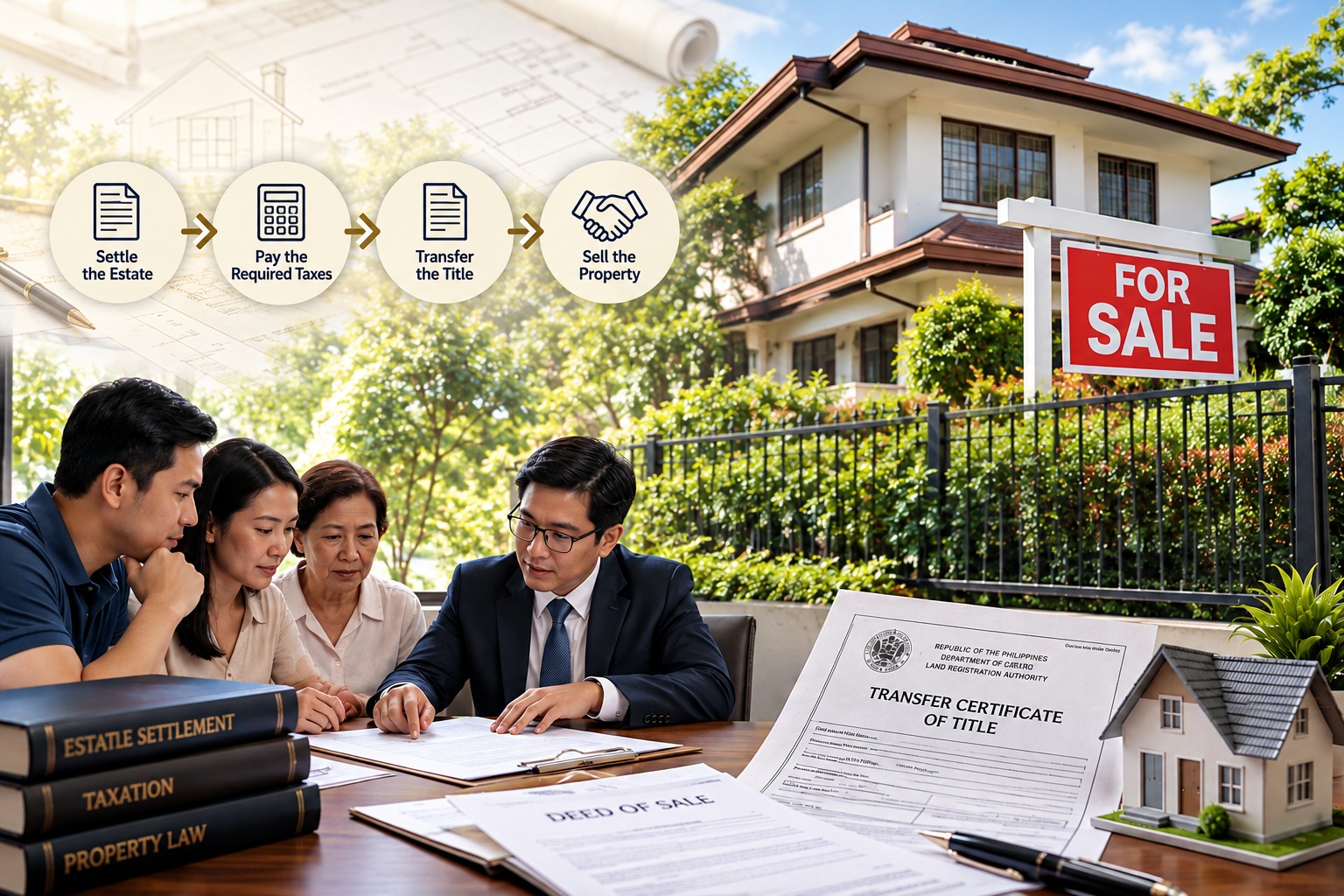
  • How to Sell the Property of a Dead Relative in the Philippines

    How to Sell the Property of a Dead Relative in the Philippines

    “While we are postponing, life speeds by.”

    — Seneca, Moral Letters to Lucilius, Letter 1, translated by Richard Mott Gummere

    By Atty. Jojo Perez | Realttorney®

    [Originally published March 2, 2024 | Substantive revision prepared November 1, 2026]

    Can you sell property that is still in a deceased relative’s name?

    Yes, heirs may arrange the sale of inherited property in the Philippines, but they must establish their rights and authority, use the correct estate-settlement documents, and comply with the applicable tax and registration requirements. Depending on the circumstances, settlement and sale may be documented together through an extrajudicial settlement of estate with sale. A separate title in the heirs’ names is not a universal prerequisite to executing the sale documents.

    Death leaves families with more than grief. It also leaves practical questions. Who may sign for the property? What if one heir is abroad? Can the buyer’s payment help fund the taxes? What happens when the family cannot agree?

    Before finding a buyer or accepting a deposit, understand what the family owns, who must participate, and which process applies. This guide focuses on an agreed extrajudicial settlement of an estate without a will. A will, unresolved debts, disputed heirship, or a proposed sale involving a minor’s share requires separate legal consideration.

    What changes when the registered owner dies

    The title may remain in the deceased person’s name, but that does not mean the heirs have no rights until a new title is issued. Under Article 777 of the Civil Code, successional rights pass at death. Where there are several heirs, the estate is generally held in common before partition, subject to payment of the deceased’s debts. Ownership rights, authority to sell the entire property, and registration of the buyer’s title are related but distinct issues. Civil Code, Articles 777 and 1078.

    Never prepare a deed making it appear that the deceased owner is still alive and personally selling the property. The proper parties must sign in their actual capacities. A notarized document cannot cure a fabricated signature or missing authority.

    Step 1: Identify the heirs and the deceased owner’s actual interest

    Do not assume that the children are the only heirs. Establish the family relationships, whether a spouse survives, and whether an heir has also died. A later death may require examination of another estate and another set of successors.

    Check whether the property was exclusively owned by the deceased, belonged to the spouses’ property regime, or was co-owned with someone else. A surviving spouse’s own interest must be distinguished from that spouse’s inheritance. The name printed on the title does not, by itself, answer every marital-property question.

    Gather the death certificate, relevant birth and marriage records, title, tax declarations, and any documents affecting ownership. Investigate inconsistent names, missing records, annotations, mortgages, occupants, and pending disputes before drafting the settlement. The property due diligence checklist provides a useful starting point for buyers.

    Step 2: Confirm that extrajudicial settlement is appropriate

    Under Rule 74, Section 1, an agreed extrajudicial settlement is available when the deceased left no will, has no debts, and the heirs are all of age or minors are represented by judicial or legal representatives duly authorized for the purpose. If there is only one heir, the appropriate instrument may be an affidavit of self-adjudication. Ende v. Roman Catholic Prelate.

    Every heir must be accounted for and properly participate in the agreed settlement, personally or through valid representation. The heirs must address existing liabilities and agree on a lawful settlement. A minor cannot simply sign an SPA, and a parent’s signature should not be assumed to supply every authority needed to dispose of the child’s property. Obtain advice about representation and any necessary court approval.

    If there is a will, it must be dealt with through the applicable probate process. If heirship, ownership, debts, or the proposed division is disputed, a court proceeding, or another appropriate remedy may be needed. Do not conceal a will or omit a family member merely to make the paperwork easier.

    Step 3: Agree on the sale terms and who may represent the heirs

    One trusted representative can make negotiations manageable. Trust, however, should be supported by a clear written mandate or authority.

    Before marketing the property, agree on the proposed price, payment terms, tax and expense allocation, brokerage commission, possession, and distribution of the net proceeds. Distinguish authority to negotiate from authority to sign a settlement or sale and authority to receive the purchase money.

    If an heir cannot personally sign, obtain an appropriately worded Special Power of Attorney. It should identify the property and expressly cover the acts the representative is expected to perform. Verify that the authority remains effective before signing and closing. A family spokesperson cannot automatically bind the other heirs.

    For an heir abroad, distinguish two usual routes: acknowledgment before an authorized Philippine consular officer, or execution before a foreign notary followed by the applicable apostille or authentication process. The correct route depends on the country and receiving office. Foreign notarization alone should not be assumed sufficient. DFA apostille and consular guidance.

    Electronic notarization has separate requirements under the Supreme Court’s rules, including a limited route for principals at Philippine foreign posts. It is not an ordinary video call with any notary. Confirm that the proposed service and document comply with the rules and are accepted for the transaction. The Effects of Electronic Notarization in Real Estate Transactions.

    Step 4: Choose the settlement and sale documents

    There are two common structures to consider.

    Settlement followed by a separate sale. The heirs first document and process the settlement, then convey the property through a separate deed of sale. The particular registration sequence should be established before the parties sign or commit funds.

    Extrajudicial settlement of estate with sale. Where legally appropriate, the heirs settle the estate and convey the identified property in a combined instrument. The Land Registration Authority publishes a standard form for an extrajudicial settlement with absolute sale. This structure does not remove either the estate-transfer or sale-transfer requirements. LRA downloadable forms.

    The choice is not determined solely by whether the deceased owned one property or several. Consider the entire estate, the property being sold, the heirs’ agreement, outstanding requirements, and the BIR and Registry of Deeds processing route. Do not omit other estate assets because the buyer wants only one parcel.

    The settlement must comply with the applicable formalities. Rule 74 requires publication of the fact of the settlement once a week for three consecutive weeks in a newspaper of general circulation. Its requirements also include a bond concerning personal property, where applicable. Publication does not make an excluded heir’s rights disappear. Ende v. Roman Catholic Prelate.

    Step 5: Settle the applicable taxes and obtain the BIR clearances

    Estate tax and taxes arising from a later sale are separate matters. Do not assume that paying one settles the other.

    For deaths on or after January 1, 2018, the regular estate tax is six percent (6%) of the net taxable estate after applicable deductions. For earlier deaths, apply the estate-tax law in force at the date of death, including its allowable deductions and any lawfully applicable amnesty or other relief. The estate-tax return is generally due within one year of death under the TRAIN law (Rep. Act No. 10963); a late settlement requires assessment of the relevant additions and available remedies. BIR Revenue Regulations 12-2018.

    An estate may still need to file a return and secure the appropriate BIR clearance for registrable property even where deductions leave no estate tax payable. The electronic Certificate Authorizing Registration, or eCAR, is a tax clearance used in the registration process. It is not a certificate guaranteeing ownership or curing an invalid settlement.

    For the sale, determine the property’s tax classification and applicable taxes rather than assuming capital gains tax applies to every transaction. Include documentary stamp tax where applicable, local transfer tax, registration charges, and any required real-property-tax clearance in the closing plan. Confirm the documents and eCAR requirements for each transfer with the relevant offices.

    If sale proceeds are needed to fund the estate obligations, arrange the payment safeguards before signing. Indicate clearly who advances the money, where it goes, what proves payment, and what happens if the transfer cannot proceed. Do not promise a fixed processing period or automatic release of a particular number of eCARs without checking the actual transaction.

    Is a new estate tax amnesty available?

    Legislative update reviewed November 1, 2026. Do not treat a pending bill as an available tax amnesty. The latest Senate hearing update verified for this article is the October 23, 2026 statement issued through Senator Panfilo Lacson’s office. It describes proposals under consideration, rather than an enacted replacement program.

    The previous amnesty and the 2026 BIR clarification

    Republic Act No. 11956 extended the previous estate-tax-amnesty period until June 14, 2025 and covered qualifying estates of persons who died on or before May 31, 2022. The BIR subsequently referred to June 16, 2025, as the operative deadline. Those dates are historical and should not be advertised as a current invitation to apply. Republic Act No. 11956.

    BIR Revenue Memorandum Circular No. 33-2026 clarified that failure to submit proof of estate settlement by that deadline does not invalidate an amnesty application, although the proof remains necessary for the eCAR. It also addresses approved installment arrangements and undeclared properties. This clarification should not be read as reopening the application period for everyone. Anyone who previously applied should have the return, payment records, and remaining requirements reviewed. BIR RMC 33-2026 official digest.

    What the Senate was considering

    At the October 23 hearing, Lacson’s office reported consideration of multiple estate-tax measures and a House proposal to extend the earlier amnesty. His Senate Bill No. 1889 instead proposes a new amnesty covering estates of persons who died on or before December 31, 2025, at 6 percent of the net estate. That proposed coverage is not an existing entitlement. Senate Bill 1889 proposal and explanatory statement.

    The hearing raised concerns about proof of death, documentary delays, and payment deadlines. The same statement says Senate President Sherwin Gatchalian generally supports amnesty but questioned why taxpayers still struggle to pay after repeated opportunities, including whether the 6 percent rate is too expensive. It would therefore be inaccurate to describe his position simply as opposition to any new amnesty. October 23 hearing statement.

    The practical advice is to prepare the documents now and have the present liability assessed. Do not assume that a proposed deadline, coverage date, rate, or waiver will survive the legislative process. Before relying on new relief, verify the enacted law, its effectivity, and the applicable BIR implementation. Estate tax amnesty must also be distinguished from local real-property-tax relief.

    Step 6: Complete registration and the agreed turnover

    Signing the documents and paying the taxes are not the final steps. Submit the proper instruments, BIR clearances, title documents, publication evidence, local tax documents, and other applicable requirements to the Registry of Deeds. Coordinate the local transfer-tax and registration deadlines rather than leaving them until the end.

    Follow through on the resulting title and updated tax declaration. Separately document possession, keys, occupants, unpaid charges, and release of the purchase-price balance. A successful registration does not physically remove an occupant or resolve a boundary or access dispute.

    A hypothetical case study involving an overseas heir

    Assume a widower dies without a will, leaving a house and lot that he exclusively owned. His wife died earlier, her estate has already been properly dealt with, and records establish that his three adult children are his only heirs. Assume there are no outstanding debts. Two children live in Metro Manila; the third lives abroad.

    The children agree to sell. They first verify the title and supporting records. The overseas child executes an appropriate SPA through the applicable consular or foreign-notarization route. The family and buyer obtain advice on using a combined settlement with sale or separate instruments, arrange publication and tax compliance, and agree in writing how any funds advanced for taxes will be protected. Registration and turnover follow once the requirements are met.

    Change one fact and the solution may change. A disputed heir, an unresolved earlier estate, a minor, a will, or a defective SPA may prevent this straightforward route.

    A buyer’s checklist before paying

    • Verify the title, annotations, actual possession, boundaries, access, and intended use.
    • Establish the deceased owner’s interest and identify every person whose participation or authority is needed.
    • Check the settlement route and independently verify the identities, signatures, and representative’s powers.
    • Obtain a written estimate and allocation of taxes and expenses, with safeguards for any advance payment.
    • Set clear document, registration, payment, and turnover milestones, including what happens if a condition fails.
    • Verify the buyer’s legal eligibility to acquire the property. Being a relative does not, by itself, make a foreign buyer qualified to own Philippine land.

    Do not rely on a notarized SPA merely because someone says everyone signed it. If a supposed signatory has died or authority has changed, the transaction must be reviewed before it proceeds.

    Frequently asked questions (FAQs)

    Must the heirs get a new title before signing a sale?

    Not in every case. A legally appropriate settlement with sale can combine the documentation. The estate and sale requirements still have to be satisfied before the buyer can complete registration.

    Can one heir sell the entire property?

    One heir’s signature ordinarily cannot bind all co-heirs without authority. Selling an undivided hereditary interest is a different transaction from selling the entire property; it can raise partition and redemption issues that need separate advice.

    What if one heir refuses to sell?

    The other heirs should not sign for that person without authority. Consider negotiation, partition, or the appropriate court remedy rather than misrepresenting consent.

    How long does the process take?

    There is no reliable universal timetable. Missing records, multiple estates, overseas execution, disputes, tax issues, and registration requirements can materially affect completion. Obtain a case-specific work plan.

    Before you put the property on the market

    The first useful step is to establish the estate’s legal and documentary position. Know the heirs, identify the proper settlement route, and work out the taxes and closing arrangements. A buyer should be able to see how the transaction will reach a valid, registrable transfer.

    Do not let the process drift. Every deferred heir signature, missing record, and unpaid tax is a problem that grows while the family waits.

    If you need help settling an estate or evaluating a proposed sale of inherited property, book a consultation with Realttorney®. Bring the available title, death, and civil registry records, tax declarations, and any settlement or amnesty documents already filed.

    This article provides general information on Philippine estate settlement and property transactions. The appropriate documents, taxes, authority, and procedures depend on the entire estate and the circumstances of the parties.


    Atty. Jojo is a real estate attorney, an estate planning attorney, a licensed real estate broker, and a PRC-accredited Lecturer/ Speaker for Training Programs in Real Estate. He is a Chartered Trust and Estate Planning (CTEP®) professional who is committed to educating Filipinos about the value and importance of having an estate plan in their lives.