Tag: technology

  • How E‑Notarization Works in the Philippines for Real Estate Documents

    How E‑Notarization Works in the Philippines for Real Estate Documents

    “The E-Notarization addresses a key limitation of the 2004 Notarial Rules, where traditional notaries public were restricted to performing notarizations only within their territorial jurisdiction.”

    – Supreme Court of the Philippines

    By Realttorney

    Introduction: The Digital Shift in Real Estate

    Imagine this: You’re an Overseas Filipino Worker (OFW) who has finally returned home to the Philippines on vacation. You need to sign a Special Power of Attorney (SPA) so your sibling can act on your behalf in a property transaction — but you’re in your home province, and the notary public is in a city hours away. Traditionally, this meant booking a bus or flight, taking time out of your vacation, and spending money to appear before a notary.

    Now, with e‑notarization, you can complete the process online — securely, legally, and without leaving your province. Under the Supreme Court’s Rules on Electronic Notarization (A.M. No. 24-10-14-SC), remote electronic notarization generally requires the participants to be within the Philippines.

    However, Rule IV, Section 5 allows a limited exception for a signatory abroad who is physically present at a Philippine embassy, Philippine consular office, or office of a Philippine Honorary Consul. The electronic notary must remain in the Philippines, verify the signatory’s location through video, and obtain confirmation of the signatory’s presence from the designated officer at the foreign post. This does not permit an overseas signatory to participate from just any location, such as a home or office. Availability must be confirmed with the relevant foreign post and electronic notary, and all other requirements of the Rules must be satisfied.

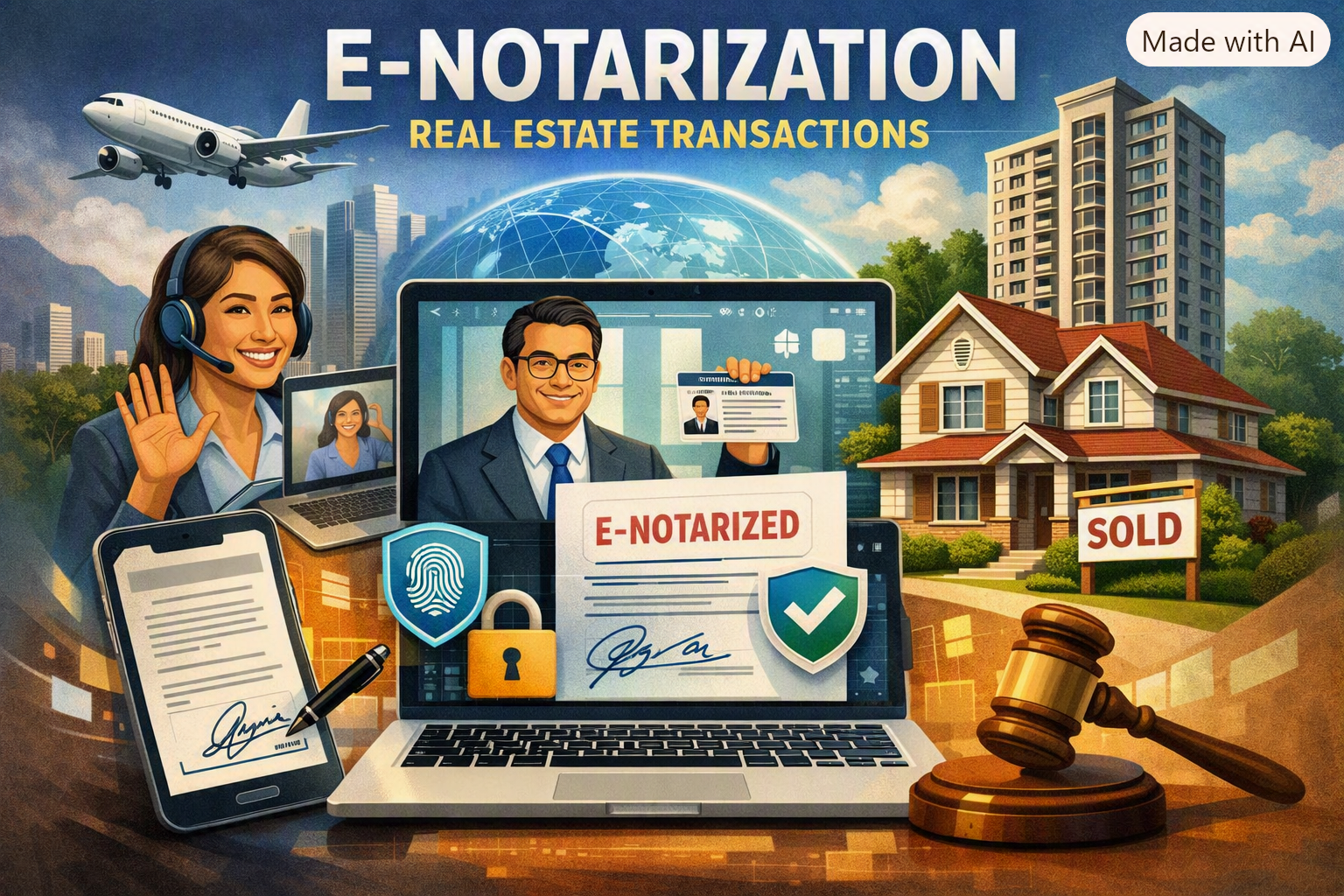
    An illustration depicting e-notarization for real estate transactions, featuring a woman with a headset, a man on a computer screen, various digital documents, a smartphone, a padlock symbol, and a house with a 'SOLD' sign in the background.

    What is E‑Notarization?

    E‑notarization refers to the process of notarizing documents electronically, using secure platforms that allow identity verification, digital signatures, and video conferencing. In the Philippines, the Supreme Court has issued rules enabling notaries public to perform notarization remotely, provided strict safeguards are followed.

    Key features include:

    • Video conferencing between the notary public and the client.
    • Digital identity verification (government IDs, biometrics).
    • Electronic signatures compliant with the E‑Commerce Act (Rep. Act No. 8792).
    • Secure archiving of notarized documents.

    Impact on RESPs

    ✅ Advantages

    1. Expanded Reach: Electronic Notaries Public can serve signatories throughout the Philippines and, subject to the Rules’ limited foreign-post exception, signatories abroad. This can help brokers coordinate document execution for clients in different locations.
    2. Efficiency in Transactions: Deeds, contracts, and SPAs can be notarized faster, reducing delays in property transfers and financing.
    3. Professional Modernization: Practitioners who adopt e‑notarization demonstrate digital competence, positioning themselves as forward‑thinking professionals.

    ⚠️ Challenges

    1. Compliance Burden: Practitioners must strictly follow Supreme Court guidelines, including secure video conferencing, identity verification, and digital archiving. Any lapse can invalidate the notarization.
    2. Technology Costs: Investment in secure platforms, e‑signatures, and cybersecurity measures is necessary. Smaller law firms may struggle with the financial burden. This may increase the total cost for notarization of the document.
    3. Recognition Issues: Some registries, banks, and government agencies may still prefer traditional notarization, creating transitional challenges.
    4. Training and Adaptation: Notaries and staff must be trained to handle digital tools and ensure compliance with evolving rules.

    ⚠️ Disclaimer

    Personally, I have not applied to become an electronic Notary Public at this time. Why? In my mind, the administrative compliance is too much for a small law firm’s operation. I am currently a Notary Public for the City of Muntinlupa. The current administrative compliance our staff goes through every single month is quite overwhelming. Therefore, I do not wish to put an additional burden on the staff at this time. E-notarization is a good concept, but I would let other legal practitioners handle this and remain content as a regular Notary Public.

    Impact on OFWs and Local Buyers

    ✅ Advantages

    1. No Travel to a Notary’s Office: Buyers physically located anywhere within the Philippines can complete notarization remotely, eliminating the need to travel to a notary’s office regardless of distance.
    2. Convenience for OFWs Back Home: OFWs who have returned to the Philippines on vacation or for good can sign documents without visiting a physical office, saving time and travel during their limited stay.
    3. Faster Processing: No need to schedule in-person appointments or coordinate travel. Documents can be notarized promptly via video conference, speeding up property acquisitions and financing approvals.
    4. Accessibility for Provincial Buyers: Buyers located in provinces far from notary offices gain easier access to notarization services, encouraging broader participation in the property market across the country, provided that proper and adequate legal due diligence on the real estate has been conducted.

    ⚠️ Risks

    1. Jurisdictional Recognition: Not all institutions (banks, registries, courts) may immediately accept e‑notarized documents. Buyers must confirm acceptance before proceeding.
    2. Cybersecurity Concerns: Sensitive personal and financial data must be protected against hacking or fraud in compliance with the Data Privacy Act of 2012.
    3. Digital Literacy Barriers: Overseas clients unfamiliar with digital tools may face difficulty navigating the process.
    4. Dependence on Internet Stability: Poor connectivity can disrupt video conferencing and delay notarization.

    📌 Practical Takeaways

    • For RESPs: Ask around to determine who has been approved by the Supreme Court as an electronic notary public.
    • For Buyers Abroad: Confirm with the relevant Philippine foreign post and a commissioned Electronic Notary Public whether the overseas procedure is available. Also confirm the receiving bank, Registry of Deeds, or government agency’s applicable submission and verification requirements.
    • For Both Parties: Prioritize cybersecurity and authenticity checks to prevent fraud. RESPs should keep in mind the “Know Your Client” protocols for clients abroad pursuant to the rules and regulations of the Anti-Money Laundering Council.

    📊 Case Scenarios

    Scenario 1: OFW Buying a Condo

    Maria is an OFW who has returned to the Philippines on vacation. She needs to sign an SPA so her brother can execute the deed of sale on her behalf for a house and lot in Gen. Trias City, Cavite. The problem: Maria is in her home province of Iloilo, while the notary public is in Manila. With e‑notarization, Maria can complete the entire process remotely from Iloilo — without purchasing a plane ticket to Manila — as long as both she and the notary are physically within the Philippines.

    Scenario 2: Broker Handling Overseas Client

    Juan, a licensed REB based in Metro Manila, assists a balikbayan client who has recently returned to the Philippines and is staying in Davao. The client needs to sign loan documents, but traveling to Manila is costly and time-consuming. Using e‑notarization, Juan and his client finalize the documents remotely — without either party traveling — closing the deal faster and enhancing Juan’s reputation as a tech‑savvy professional.

    🔐 Safeguards and Best Practices

    • Identity Verification: Always use government‑issued IDs and biometric checks.
    • Secure Platforms: Choose Supreme Court‑accredited e‑notarization systems.
    • Data Protection: Encrypt all communications and archives.
    • Client Education: Guide overseas buyers through the digital process to reduce confusion.

    ✍️ Conclusion

    E‑notarization is a game‑changer for Philippine real estate transactions. It bridges geographic distances within the Philippines — connecting RESPs and their clients across provinces and regions without the burden of travel. Yet, it also demands vigilance in compliance, recognition, and security.

    For RESPs, early adoption and understanding mean positioning themselves as trusted advisors in the digital era. For buyers in the Philippines, e-notarization can reduce travel to a notary’s office. For eligible signatories abroad, the limited foreign-post procedure offers another possible route, subject to the required attendance, verification, and safeguards.

    📣 Call to Action

    If you’re a licensed REB, now is the time to think about e‑notarization. Determine whether it will be advantageous or not to your clients — particularly those located in provinces or remote areas who stand to benefit most.

    If you are buying property, ask your licensed real estate broker or real estate attorney which notarization route fits your location and documents. If you are abroad, check the foreign-post procedure described above. Then confirm service availability and the receiving institution’s requirements before making arrangements.

    👉 Stay ahead of the curve. The future of real estate transactions in the Philippines is digital — and e‑notarization may lead the way, bringing notarial services closer to every Filipino, wherever they are in the country.

    ——-

    Atty. Jojo is a real estate attorney, an estate planning attorney, a licensed real estate broker, and a PRC-accredited Lecturer/ Speaker for Training Programs in Real Estate. He is committed to helping new and veteran real estate service practitioners be well-informed about the latest laws, rules, regulations, and information relevant to the real estate service sector.

  • Keeping the Human Advantage: Real Estate Brokerage in the Philippines and AI

    Keeping the Human Advantage: Real Estate Brokerage in the Philippines and AI

    “AI can give answers. People give purpose. In Philippine real estate, purpose preserves value.”

    – Ernesto C. Perez II, CTEP, REB, Real Estate Attorney & Author

    By Realttorney®

    Simon Sinek’s recent warnings about AI are not anti-technology. They are a call to defend the human processes that cultivate judgment, trust, and purpose. For Philippine real estate professionals (lawyers, brokers, salespersons, appraisers, and allied advisers), the strategic response is threefold: (1) automate routine tasks but never outsource formation of judgment, (2) productize and charge for human-only services, and (3) deploy AI under strict human-in-the-loop, privacy, and ethical safeguards. This article provides implementation guidance, Philippine case examples, and templates for publication and compliance.

    The problem Simon Sinek warns about. Why it matters

    In his recent interview by Simon Squibb posted on YouTube, Simon Sinek sounded a clear alarm: artificial intelligence will rapidly absorb routine tasks and produce high-quality outputs, and in doing so, it risks eroding the very processes — the struggle, practice, and imperfect learning — that build human judgment, empathy, and trust. The result, he warns, could be a society and economy with excellent answers but diminished human connection.

    For Philippine real estate service practitioners (RESPs), this is no longer a theoretical debate. The local market is already being reshaped by Proptech platforms, AI-powered listing search and match functions, and new AI concierge apps that promise faster, cheaper customer journeys.

    The strategic question for veteran and novice RESPs alike is simple: how do we use AI’s strengths while preserving and amplifying the uniquely human skills buyers and sellers still (and will always) pay for — judgment, relationships, stewardship, and ethical responsibility?

    Furthermore, recent regulatory guidelines make it clear that deploying AI in commercial services is not a legal free-for-all. The principles attached to privacy, transparency, and contractual safeguards all matter.

    This article translates Sinek’s core message into concrete, role-specific guidance for the Philippine context, with practical steps, and short case examples from the local market. This is an update of the first article that I wrote about artificial intelligence, published on April 20, 2023, entitled “Redefining Real Estate: How Brokers Can Leverage AI to Elevate Their Business.”

    Current Philippine Landscape: Speed of Adoption and Regulatory Guardrails

    Proptech marketplaces (Lamudi, Carousell/Property24, and other local portals) and AI-enabled property platforms are active in the Philippines. They remain major gateways for buyers and sellers and already use automated search, chatbots, and analytics to improve matching during search inquiries. In May 2025, an Inquirer Business article featured the launch of an AI-powered real estate concierge app in the Philippines that is designed to serve property buyers, owners, brokers, and global investors.

    These tools accelerate the front end (lead generation, matching, initial Q&A) but do not replace legal title checks, fiduciary advice, or complex negotiations. The National Privacy Commission’s (NPC) advisory clarifies that the Data Privacy Act of 2012 and other regulations apply to AI systems that process personal data. These firms must embed in their platform the guidelines on transparency, consent, lawful basis, and protection of the rights of the subject.

    The Core Thesis: Double Down on the Human Advantage

    AI will win on speed, pattern-matching, and commoditized outputs. Human professionals must win on purpose, empathy, ethical judgment, and long-term stewardship. Practically, this means:

    1. Stop competing with machines at their game (raw speed or generic outputs).

    2. Productize and charge for what only humans can do: dispute navigation, legacy planning, nuanced negotiation, and trust-based advisory.

    3. Use AI to remove friction (collecting and sorting data, document drafting, repetitive tasks) and free time to deepen human relationships.

    4. Deploy AI under strict human-in-the-loop, privacy and ethical safeguards.

    The Veteran REBs’ Takeaway

    Veteran real estate brokers possess deep experiential capital — the negotiation instincts, accumulated judgment, reputational integrity, and established networks that matter most to clients. Sinek’s counsel to “defend the struggle” means deliberately preserving these activities that sharpen interpersonal skills.

    What are the strategic moves that the veteran REBs must make at this time? As a professional who has studied, consumed a lot of information, and lectured about AI and its effect on the real estate service sector for more than two years now, here are my humble suggestions:

    1. Reposition from “transactional agent” to “trusted steward”. Offer explicit advisory packages for things the market cannot automate, like legacy transfers, legal due diligence on land titles, tax-efficient structuring of real estate holdings, and asset preservation workshops. These are services where decades of knowledge, experience, and judgment matter.

    2. Productize judgment and expertise. Create billable advisory “blocks” (e.g., Effective Estate Transfer Roadmap, Identifying Fake Land Titles and Other Risk Assessment, Post-sale Conflict Management, etc.) with clear deliverables and fees so clients understand they are paying for human expertise, not just administrative work.

    3. Delegate automation, but guard learning. Use AI to draft non-substantive documents, summarize market surveys, or triage leads — but require human review for any client-facing legal advice, negotiation strategies, or final documents. Institutionalize a human-in-the-loop (HITL) policy.

    4. Adopt “human-first” client experience. Combine AI triage (automated listing matches, initial KYC) with mandatory human touchpoints for decision events: negotiation, contract signing, and referral to a real estate attorney.

    The Real Estate Newbies’ Takeaway

    New entrants must learn faster than ever, but not outsource their learning to AI. Sinek warns that when AI supplies perfected outputs, people can stop learning the processes that build competence.

    Immerse yourself in the “grind” of doing the mundane and the basics. Learn everything about our profession and its best practices. Then, understand where to implement the following strategic moves in your daily or weekly workflow:

    1. Use AI as training wheels — not a substitute. Employ AI for research and draft generation of market summaries and marketing copy. But always review, examine, and evaluate the output. Fact-check, if necessary. However, always: (a) pre-write your negotiation scripts by hand, (b) role-play negotiations with mentors, and (c) write debrief notes to retain learning.

    2. Practice “muscle memory” through role-play. Real negotiation skill develops in messy, imperfect practice. Schedule daily/weekly role plays with mentors and record the entire exchange. Then upload it to your favorite AI platform and ask how you can do better at negotiating or generating leads.

    3. Build a distinctive ‘Why’. A clear niche and purpose accelerate differentiation (e.g., “I help OFWs protect inherited properties from double sale and title fraud”). Purpose guides content, referrals, and how you price human advisory services.

    4. Create Your Brand. As a newbie, the main question to answer is: why would a prospective client choose you over a veteran real estate broker? What sets you apart or makes you different from other licensed real estate brokers with years of experience? In other words, develop, create, or fashion your unique selling proposition. Then, make your vision and mission statement, and list the values you want to be known for. Use AI for this very important exercise/task.

    Rules of Engagement with AI

    At this point, we must create a framework that should be implemented when the RESP interacts with AI. These are the elements of the framework:

    1. Human-in-the-loop (HITL): Any AI output that influences a client decision or legal document must be reviewed by the licensed professional.

    2. Transparency & consent: Disclose to clients when AI was used in producing advice or documents. Moreover, it is highly important to obtain consent when processing personal data. NPC guidance and advisories make these obligations non-optional for personal data processing.

    3. Contractual safeguards for data gathering: Legal commentary and law firm primers emphasize contractual safeguards for AI deployments to assure data privacy. The RESP must learn and understand warranties, data-use limitations, and audit rights in contracts (data residency, deletion rights, no training on client data without consent).

    4. Measure what matters: Track Net Promoter Score (NPS), dispute frequency, and time-to-close and repeat referrals, and client retention for human touchpoints — not only volume of automated touches. Use these Key Performance Indicators (KPIs) to justify the cost of preserving human interactions.

    Ethical and Regulatory Considerations

    The NPC’s AI guidance and related advisories apply where personal data is processed by AI (training, testing, deployment). That means licensed real estate brokers and salespersons must treat AI deployments under existing data-privacy rules: provide transparency, ensure data minimization, and permit human intervention in automated decision-making. Failure to do so exposes the RESP to regulatory and reputational risk.

    The use of AI should also be implemented in conjunction with our compliance with PRBRES Resolution No. 39, Series of 2019 [The Code of Ethics and Responsibilities for Real Estate Service Practitioners], as well as other AI Governance Frameworks that will be issued in the coming years. The ethical use of AI in the real estate services sector is still a work in progress.

    In conclusion, Simon Sinek’s message is neither Luddite panic nor techno-optimism. It’s a call to preserve the human processes that produce true professional judgment. In the Philippines, where family, legacy, personal trust, and integrity drive many real property decisions, the professional who can blend efficient AI tools with deliberate human stewardship will not only survive but thrive. Measure success in client outcomes and relationships — not in how many repetitive tasks you automated.

    So, are you ready to fully embrace AI and integrate it into your practice? Tell us your fears and apprehensions about AI. Or share with us three concrete steps you will take in the next 90 days to grow your practice using AI.

    Sources and Further Reading:

    1. Simon Sinek — You’re Being Lied To About AI’s Real Purpose (YouTube). YouTube
      https://www.youtube.com/watch?v=W2a_adkjqiA
    2. National Privacy Commission — Advisory / Guidelines on AI systems and DPA application (NPC). National Privacy Commission
      https://privacy.gov.ph/wp-content/uploads/2025/02/Advisory-2024.12.19-Guidelines-on-Artificial-Intelligence-w-SGD.pdf
    3. Quisumbing Torres — Deploying AI in the Philippines? 10 things you need to know (legal primer). Quisumbing Torres
      https://www.quisumbingtorres.com/en/newsroom/2025/deploying-ai-in-the-philippines
    4. Philstar — AI-powered buying, selling, renting property app launched (Nov 14, 2024). Philstar
      https://www.philstar.com/lifestyle/gadgets/2024/11/14/2399831/ai-powered-buying-selling-renting-property-app-launched
    5. Inquirer Business — NoneAway officially launches AI Concierge (May 15, 2025). Inquirer Business
      https://business.inquirer.net/525591/noneaway-officially-launches-ai-concierge-the-first-ai-powered-real-estate-app-in-the-philippines-for-buyers-owners-brokers-and-global-investors
    6. Lamudi Philippines — Proptech & features commentary (Lamudi Journal). Lamudi Philippines
      https://www.lamudi.com.ph/journal/nothing-fear-about-emerging-proptech/

    Atty. Ernesto C. Perez II, CTEP, REB, [Realttorney]. Licensed for reuse under CC BY-NC with attribution. For permissions and consultancy, visit realttorney.com/contact.

    ——-

    Atty. Jojo Perez is a real estate attorney, an estate planning attorney, a licensed real estate broker (since 2009), and a PRC-accredited Lecturer/ Speaker for Training Programs in Real Estate (since 2013). He is committed to helping new and veteran real estate service practitioners be well-informed of the latest laws, rules, regulations, and information relevant to the real estate service sector.

  • The Digital Barrister: Navigating AI in the Philippine Legal Profession

    “The legal profession, in particular, has not fully grasped the possibilities of artificial intelligence available to it… But instead of shying away from this challenge, the only way forward is to keep abreast with these developments to come up with more definitive rules in the use of AI and similar technologies.”

    – Mr. Justice Marvic M.V.F. Leonen, Senior Associate Justice

    By Realttorney®

    Artificial intelligence (AI) is no longer a futuristic fantasy but a tangible force reshaping industries worldwide, and the legal profession in the Philippines is no exception. While the full impact is still unfolding, AI’s real effects are already being felt in various aspects of legal practice, presenting both opportunities and challenges.

    Several days ago, the Sandiganbayan berated a lady lawyer over erroneous citations in the pleadings she filed before the Anti-Graft Court’s 7th Division. The lady lawyer admitted that the pleading she filed was crafted with the assistance of artificial intelligence tools. [Read the article here: https://www.onenews.ph/articles/sandigan-calls-out-lawyer-who-used-ai-in-pleadings]

    This case has shed a bright light on the use of artificial intelligence in the legal profession in the country vis-a-vis the ethical standards that all lawyers must comply with.

    On one hand, AI offers the potential for increased efficiency and productivity. Tasks like legal research, document review, and contract analysis can be automated or significantly augmented by AI-powered tools, freeing up lawyers’ time for more complex strategic work and client interaction. AI can sift through vast amounts of legal data with speed and accuracy that humans cannot match, potentially leading to more thorough case preparation and better legal outcomes. Furthermore, AI-powered platforms can assist in tasks like scheduling, case management, and even initial client communication, streamlining law firm operations. This increased efficiency can translate to more affordable legal services, potentially expanding access to justice for a wider segment of the population.

    However, the integration of AI into the Philippine legal landscape also raises significant concerns and challenges similar to the recent case cited above. The accuracy and reliability of AI algorithms depend heavily on the data they are trained on. Biases in this data can lead to discriminatory outcomes, raising ethical questions about fairness and equity in the application of AI in legal contexts. Data privacy and security are also paramount concerns, given the sensitive nature of legal information. Moreover, the legal framework in the Philippines is still grappling with how to regulate and address issues arising from AI’s use, such as accountability for errors made by AI systems and the potential displacement of legal professionals in certain roles. The need for human oversight and ethical guidelines in the development and deployment of AI in law is therefore crucial.

    To effectively navigate this evolving landscape, understanding the nuances of AI in the legal profession is essential. As a real estate attorney, I adhere first and foremost to the  Code of Professional Responsibility and Accountability (CPRA) promulgated by the Supreme Court of the Philippines, then to the Code of Conduct for Real Estate Service Practitioners. Providing the best legal advice for RESPs can be aided by artificial intelligence. I have proven this because a lawyer who uses AI is far more effective and efficient than a lawyer who ignores AI.


    Learn How AI is Truly Transforming the Philippine Legal Profession!

    Are you ready to understand the real impact of Artificial Intelligence on legal practice in the Philippines?

    The Center for Global Best Practices invites you to an insightful seminar designed to equip legal professionals with the knowledge and strategies to navigate the age of AI.

    Gain valuable insights on:

    • Current applications of AI in legal research, document review, and practice management.
    • The opportunities for increased efficiency and productivity in your legal work.
    • The critical ethical and legal challenges posed by AI adoption.
    • Strategies for integrating AI tools effectively and responsibly.
    • The future of legal practice in the Philippines in the context of AI advancements.

    Don’t get left behind. Understand the real effects of AI and position yourself for success in the evolving legal landscape.

    Click HERE for FULL Details: http://bit.ly/3JesB3Q

    Click HERE to REGISTER: https://bit.ly/4oCxLag

    Limited slots available! Secure your spot today.

    ——-

    Atty. Jojo is a real estate attorney, an estate planning attorney, a licensed real estate broker, and a PRC-accredited Lecturer/ Speaker for Training Programs in Real Estate. He is committed to helping new and veteran real estate service practitioners be well-informed of the latest laws, rules, regulations, and information relevant to the real estate service sector.

  • Building Smart Sustainable Communities: Key Legislative Updates in the Philippines

    “At the same time we’re solving for climate change, we’re going to be building cities for three billion people.”

    – Peter Calthrope, Architect & Urban Planner

    (Par 1 of 2)

    By Realttorney®

    Last April 4, 2025, I presented a topic during the CPD Event of the Real Estate Brokers Association of the Philippines (REBAP), entitled “Upcoming Legislation Impacting the Real Estate Industry in the Philippines.” I discussed the following: (1) Amendments to the REIT Act; (2) Tax on Non-Essential Goods; (3) Amendments to the Investors’ Lease Act; (4) the ARROW Act; and (5) the National Land Use Act.

    Since the presentation was only for two hours, I did not discuss two pending legislations at the Senate of the Philippines that echoed my presentation way back on July 8, 2023, during the 2nd National General Membership Meeting of REBAP in Tagaytay City. The Presentation was entitled, “Building Climate Resilient Human Settlements in the Philippines.”

    Here are the important features of Senate Bill No. 65 and Senate Bill No. 298, and how they align with the Smarter City Framework published by the Department of Science and Technology (DOST) in 2024.

    Senate Bill No. 65 (SBN 65) is authored by Senator Pia S. Cayetano. The short title of the bill is “Sustainable Cities and Communities Act”.

    It aims to provide for the development of sustainable cities and communities in the country. The bill seeks to fulfill international obligations concerning Sustainable Development Goal 11 (SDG 11), which is to “make cities and human settlements inclusive, safe, resilient and sustainable”. It also aims to address the problems caused by rapid urban growth, such as urban poverty, inequality, homelessness, and informal settlements.

    Policy Declaration: The State policy includes undertaking a program of urban land reform and housing to provide affordable, decent housing and basic services to underprivileged and homeless citizens. It also declares the policy to make cities safe and sustainable by ensuring access to safe and affordable housing and upgrading slum settlements. Furthermore, the State shall invest in public transport, create green public spaces, and improve urban planning and management in a way that is both participatory and inclusive.

    Model for Sustainable Cities and Communities: SBN 65 outlines elements that sustainable cities or communities should possess during their transition. These include:

        *   Affordable housing.

        *   Accessible healthcare services and facilities.

        *   Accessible social services for all, especially the vulnerable & disadvantaged.

        *   Child care facilities, youth centers, and centers for senior citizens.

        *   Efficient, accessible, and affordable public transport systems.

        *   Alternative eco-friendly transport means like walking, biking, scooters, etc.

        *   Safe, accessible, and enjoyable areas of open space.

        *   Preference for the use of renewable resources.

       *   Waste management systems with recycling.

        * Energy-efficient homes.

        *   Strong community linkages for peace and order.

        *   Access to sports and cultural activities.

    Indicators: According to SBN 65, the National Economic and Development Authority (NEDA) shall set targets based on indicators, taking into consideration SDG 11, to determine if a city or community has fully transitioned into a sustainable city or community. Examples of indicators include urban population living in slums, public transport access, sustainable urbanization rates, urban planning management with civil society participation, deaths and injuries from natural disasters, economic losses from natural disasters, solid waste management, urban air pollution, and integrated and local disaster risk management.

    Support and Incentives: The bill mandates the Department of Interior and Local Government (DILG) to provide necessary technical assistance and resource augmentation to Local Government Units (LGUs) to assist them in the transition. NEDA and other related agencies are also mandated to provide support and input. The DILG shall develop a grant or cash award incentive scheme for LGUs that achieve their annual targets set by NEDA. Finally, LGUs are authorized to enter into contracts and receive grants to support efforts towards building a Smart City.

    Meanwhile, Senate Bill No. 298 (SBN 98) is authored by Senator Alan Peter S. Cayetano. The title of this bill is “Smart Philippines Act”.

    Its purpose is to establish a framework for a Smart Philippines, ensuring accessible and affordable internet for all. The bill aims to fast-track efforts towards the development of smart cities and municipalities to secure the future of Filipinos through technology and innovation, and to ensure digital inclusion for every Filipino.

    Under SBN 298, the State recognizes science and technology as essential for national development and progress, prioritizing research, development, invention, innovation, and promoting smart technologies. It acknowledges the need for a “digital highway” for the digital economy. The State ensures all Filipinos have access to affordable, quality, and up-to-date information and communication technologies (ICTs), including reliable internet service, internet-enabled devices, online content, digital literacy training, technical support, and online privacy and cybersecurity.

    Definition of Smart City/Municipality: A smart city or municipality is defined as a community where innovative, advanced, and trustworthy ICTs and related mechanisms are applied to: improve residents’ health and quality of life; increase efficiency and cost-effectiveness of civic operations; promote economic growth; and create a safer, more secure, sustainable, resilient, livable, and workable community. This involves gathering, analyzing, and communicating data from civic systems and infrastructure, making improvements based on data, coordinating with public and private entities (like utilities), and integrating measures for cybersecurity, privacy protection, impact measurement, and regional coordination.

    Definition of Digital Inclusion: This new concept is defined as activities necessary to ensure all individuals have the opportunity to interconnect through access to affordable ICTs, including reliable internet, suitable devices, and engaging online content. It also includes access to digital literacy training, quality technical support, and assurance of online privacy and cybersecurity.

    Another provision of SBN 298 that provides an added layer of bureaucracy is the creation of the Smart Philippines Council (SPC), which will be the overall policy-making and implementing body to monitor the implementation of the provisions of the proposed legislation. The SPC shall be composed of secretaries from key government agencies, including DICT (Chair), DILG (Co-Vice Chairperson), and DOST (Co-Vice Chairperson), along with other secretaries, LGU representatives, and private sector/academe representatives.

    Smart Philippines Initiative: The SPC shall create a five-year strategic action plan within six months upon the effectivity of the law, focusing on modernizing digital infrastructure, health, transportation, education, finance, and urban development. The initiative will prioritize activities such as identifying barriers to digital inclusion, studying subsidies for LGUs for broadband, studying broadband affordability, demonstrating scalable smart city technologies, encouraging data sharing and best practices, promoting industry standards and interoperability, promoting a skilled workforce and inclusion, fostering the smart city technology industry, encouraging adoption, and safeguarding cybersecurity and privacy. This initiative should complement existing DICT programs.

    Smart Philippines Pilot Program: The SPC will provide technical support and expertise to LGUs. A pilot program will be established to assist financially unable LGUs from different regions with funding for modernization programs.

    Smart Philippines Resource Guide: Based on the Initiative, the SPC will create a guide to assist LGUs in developing their own smart programs, which will be available online for free. It is worth noting that the City of General Trias in the Province of Cavite passed City Ordinance No. 21-11 (General) entitled “General Trial Smart City Digital Governance Program – Citizens Registration”. At least, we know of one LGU that is seriously considering the great benefits of establishing a smart city in its jurisdiction.

    Finally, the DICT, in coordination with DILG and DOST, is the primary agency responsible for implementation, ensuring mandates are fulfilled and cooperation or partnerships are established. A tall order, especially when you read that most of the provisions are motherhood statements that may have difficulties during the implementation, despite the fact of an initial funding of PhP 100 million from the National Government.

    Both Senate Bill No. 65 and Senate Bill No. 298 are broadly aligned with the DOST Framework for Smart Sustainable Communities and Cities. When read together, the overarching goal of both Senate Bills and the DOST Framework is the development of cities and communities that improve the quality of life for residents.

    The DOST Framework specifically uses the term “Smart Sustainable Communities and Cities”, integrating both concepts, similar to how SBN 65 focuses on sustainability and SBN 298 on “smartness”, which includes sustainability in its definition.

    Leveraging Technology. The DOST Framework promotes leveraging science, technology, and innovation and highlights smart city solutions and data infrastructure. SBN 298 is centered around establishing a framework for a “Smart Philippines” by applying innovative technologies, particularly ICTs, and emphasizing digital infrastructure and data utilization. While SBN 65 is more focused on social and environmental aspects of sustainability, the implementation of many of its goals (like improving public transport or waste management) can be significantly enhanced by smart technologies, which aligns with the DOST Framework’s approach.

    Data Importance. The DOST Framework strongly emphasizes the importance of data infrastructure, data integration, analysis, utilization for decision-making, and protection. SBN 298’s definition of a smart city also highlights gathering, analyzing, and using data and includes safeguarding privacy and data management as a priority, directly aligning with the DOST’s view of data as the “new ‘oil’”. SBN 65’s reliance on indicators also necessitates data collection and analysis.

    Multi-stakeholder Approach: The DOST Framework identifies the roles of LGUs, industries, SMEs, academe, and DOST in achieving smart and sustainable cities. To reiterate, SBN 298 creates the Smart Philippines Council comprising representatives from various government agencies, LGUs, the private sector, and academe, and explicitly mandates collaboration with public and private stakeholders. Meanwhile, SBN 65 involves national government agencies supporting LGUs.

    Key Sectors: The priority areas and themes covered in both bills largely overlap with those identified in the DOST Framework’s desired outcomes and indicators. Examples include:

    • Health and Living Recreation (DOST) aligns with Accessible Healthcare Services and Facilities (SBN 65) and Health Modernization (SBN 298).
    • Transportation and Mobility (DOST) aligns with Efficient, Accessible, and Affordable Public Transport and Alternative Means (SBN 65) and Transportation Modernization (SBN 298).
    • Environmental Quality (DOST) aligns with Waste Management, Renewable Resources (SBN 65), and Environmental resources – DENR is part of SPC (SBN 298).
    • Economic Opportunity (DOST) aligns with Economic Development (DOST desired outcome) and Finance modernization seen in SBN 298. While SBN 65 mentions employment opportunities.
    • Governance (DOST) aligns with Government Efficiency (DOST desired outcome) and Urban planning management (an SBN 65 indicator).
    • Safety, Security and Resilience (DOST) aligns with Strong Community Linkages for Peace and Order (SBN 65) and Public Safety (DOST desired outcome). SBN 65 indicators cover natural disasters and safe spaces. Meanwhile, SBN 298 includes creating a safer and more secure community as part of the smart city definition.
    • Urban Planning (DOST) aligns with improving urban planning and management (SBN 65) and Urban development modernization (SBN 298).
    • Education (DOST) aligns with Education modernization (SBN 298).

    Role of DOST: The DOST Framework is led by DOST-PCIEERD and DOST Regional Offices. SBN 298 explicitly includes the DOST Secretary as a Co-Vice Chairperson of the Smart Philippines Council and designates DOST as one of the key agencies coordinating the implementation of the Act. This inclusion indicates that SBN 298 is intended to align with and potentially build upon DOST’s efforts and expertise in science, technology, and innovation for smart cities. SBN 65 doesn’t explicitly mention DOST, but its reliance on NEDA and DILG for implementation could involve consultation with agencies like DOST that have relevant expertise.

    Framework Development: The DOST Framework serves as a guide. SBN 298 explicitly aims to establish a national framework (“Smart Philippines Framework”) and a strategic action plan (“Smart Philippines Initiative”), which aligns with the need for a structured approach implied by the DOST Framework.

    In summary, both Senate Bills align with the DOST Smarter City Framework by addressing the development of sustainable and/or smart cities and communities in the Philippines, emphasizing improved services, quality of life, and the involvement of multiple stakeholders. SBN 298 shows particularly strong alignment with the “Smart” aspects through its focus on technology, digital infrastructure, and data, and includes DOST in its governing body. SBN 65 strongly aligns with the “Sustainable” aspects and the integration of UN SDGs highlighted in the DOST Framework.

    They represent legislative efforts to create the policy and structural support necessary to realize the vision outlined in the DOST Framework.

    In the next part of the series, we will discuss the potential implications of these bills on the real estate industry, considering the benefits, challenges, and financial implications for various stakeholders. We shall also discuss whether these two bills are in alignment with the DOST Smarter Sustainable Communities and Cities Framework that was published in 2024.

    For now, tell us what you think about creating Smart Cities in the Philippines, and are you willing to live in one?

    ——-

    Atty. Jojo is a real estate attorney, an estate planning attorney, a licensed real estate broker, and a PRC-accredited Lecturer/ Speaker for Training Programs in Real Estate. He is committed to helping new and veteran real estate service practitioners be well-informed of the latest laws, rules, regulations, and information relevant to the real estate service sector.