
“The legal profession, in particular, has not fully grasped the possibilities of artificial intelligence available to it… But instead of shying away from this challenge, the only way forward is to keep abreast with these developments to come up with more definitive rules in the use of AI and similar technologies.”
– Mr. Justice Marvic M.V.F. Leonen, Senior Associate Justice
By Realttorney®
Artificial intelligence (AI) is no longer a futuristic fantasy but a tangible force reshaping industries worldwide, and the legal profession in the Philippines is no exception. While the full impact is still unfolding, AI’s real effects are already being felt in various aspects of legal practice, presenting both opportunities and challenges.
Several days ago, the Sandiganbayan berated a lady lawyer over erroneous citations in the pleadings she filed before the Anti-Graft Court’s 7th Division. The lady lawyer admitted that the pleading she filed was crafted with the assistance of artificial intelligence tools. [Read the article here: https://www.onenews.ph/articles/sandigan-calls-out-lawyer-who-used-ai-in-pleadings]
This case has shed a bright light on the use of artificial intelligence in the legal profession in the country vis-a-vis the ethical standards that all lawyers must comply with.
On one hand, AI offers the potential for increased efficiency and productivity. Tasks like legal research, document review, and contract analysis can be automated or significantly augmented by AI-powered tools, freeing up lawyers’ time for more complex strategic work and client interaction. AI can sift through vast amounts of legal data with speed and accuracy that humans cannot match, potentially leading to more thorough case preparation and better legal outcomes. Furthermore, AI-powered platforms can assist in tasks like scheduling, case management, and even initial client communication, streamlining law firm operations. This increased efficiency can translate to more affordable legal services, potentially expanding access to justice for a wider segment of the population.
However, the integration of AI into the Philippine legal landscape also raises significant concerns and challenges similar to the recent case cited above. The accuracy and reliability of AI algorithms depend heavily on the data they are trained on. Biases in this data can lead to discriminatory outcomes, raising ethical questions about fairness and equity in the application of AI in legal contexts. Data privacy and security are also paramount concerns, given the sensitive nature of legal information. Moreover, the legal framework in the Philippines is still grappling with how to regulate and address issues arising from AI’s use, such as accountability for errors made by AI systems and the potential displacement of legal professionals in certain roles. The need for human oversight and ethical guidelines in the development and deployment of AI in law is therefore crucial.
To effectively navigate this evolving landscape, understanding the nuances of AI in the legal profession is essential. As a real estate attorney, I adhere first and foremost to the Code of Professional Responsibility and Accountability (CPRA) promulgated by the Supreme Court of the Philippines, then to the Code of Conduct for Real Estate Service Practitioners. Providing the best legal advice for RESPs can be aided by artificial intelligence. I have proven this because a lawyer who uses AI is far more effective and efficient than a lawyer who ignores AI.
Learn How AI is Truly Transforming the Philippine Legal Profession!
Are you ready to understand the real impact of Artificial Intelligence on legal practice in the Philippines?
The Center for Global Best Practices invites you to an insightful seminar designed to equip legal professionals with the knowledge and strategies to navigate the age of AI.
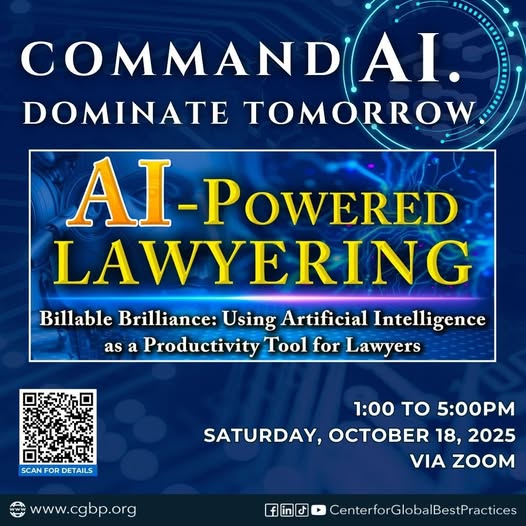
Gain valuable insights on:
- Current applications of AI in legal research, document review, and practice management.
- The opportunities for increased efficiency and productivity in your legal work.
- The critical ethical and legal challenges posed by AI adoption.
- Strategies for integrating AI tools effectively and responsibly.
- The future of legal practice in the Philippines in the context of AI advancements.
Don’t get left behind. Understand the real effects of AI and position yourself for success in the evolving legal landscape.
Click HERE for FULL Details: http://bit.ly/3JesB3Q
Click HERE to REGISTER: https://bit.ly/4oCxLag
Limited slots available! Secure your spot today.
——-
Atty. Jojo is a real estate attorney, an estate planning attorney, a licensed real estate broker, and a PRC-accredited Lecturer/ Speaker for Training Programs in Real Estate. He is committed to helping new and veteran real estate service practitioners be well-informed of the latest laws, rules, regulations, and information relevant to the real estate service sector.
Discover more from Realttorney®
Subscribe to get the latest posts sent to your email.
 Realttorney®